Sourced fact
The News
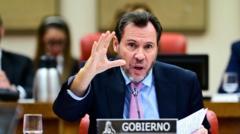
Spanish Transport Minister Óscar Poñente has resigned six days after the deadly high-speed train accident that killed 69 people and injured dozens in the suburbs of Madrid. The minister announced his decision to step down before parliament late Tuesday evening, including new measures to enhance railway safety.
Poñente clarified that having a transport minister in a country like Spain after two such serious accidents within less than a year is unacceptable, referring to the fatal accident that occurred in January in Andalusia. He also noted that he made the resignation decision immediately following the disaster on October 28 when a high-speed train operated by Renfe collided with a stationary train belonging to Alvia.
The minister faced mounting pressure from opposition parties and some allies of his government who demanded his resignation, while audio recordings leaked to Spanish media revealed conversations between train drivers and the control center just minutes before the disaster. These recordings show that Madrid's control center gave a movement signal to a train despite another train being stopped on the track 25 kilometers ahead.
At the end of the parliamentary session during which the minister faced questioning, Prime Minister Pedro Sánchez confirmed that authorities would work to reveal all details of this tragedy to reach its true bottom.
Analysis & context
Analysis & Context
From an analytical perspective, Poñente's resignation is a rare precedent in the Spanish political system and demonstrates the severity of responsibility placed on government officials after major disasters. Linking the two accidents within less than a year reflects the hardline public opinion in Spain towards any administrative or technical negligence that could lead to massive human losses.
In the broader context, the railway transport sector in Spain remains one of the most important economic and security pillars, especially with heavy reliance on high-speed trains to connect major cities. Train collisions involving passenger trains are relatively rare but always catastrophic, making any malfunction in control systems or communication between supervision centers and train drivers a key focus point for any criminal or administrative investigation.
Meanwhile, Prime Minister Pedro Sánchez's reaction, calling on authorities to "reach all details of this tragedy," reflects international and regional expectations for comprehensive and transparent investigations into such incidents. The public and political pressure on the Spanish government to launch an independent inquiry may change the course of government work and affect political alliances supporting the current government.
This crisis also shows how modern technologies in managing train traffic can be a double-edged sword; on one hand, they facilitate rapid transport, but on the other, they increase control complexity if there are no clear protocols for communication between drivers and control centers.