Sourced fact
The News
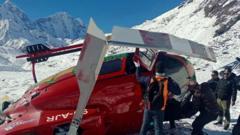
An Indian tourist died after two helicopters collided while attempting to land near Everest Base Camp, officials told the British newspaper BBC News. The incident occurred at 8:15 a.m. local time in the village of Vireche, located about 12 kilometers south of the base camp, where the rotors of the two aircraft struck each other just as they were landing.
Vistara Air, which owned one of the helicopters, stated that the deceased was Vasanth Kumar Balaramodu, while another passenger and the pilot were injured but rescued and transferred to Kathmandu. The company also noted that a third aircraft belonging to Air Dynasty was carrying cargo and had a single crew member who suffered no injuries during the incident.
A spokesperson for the Solukhumbu district in Nepal said the injured passenger was a New Zealander, while a representative of Nepal's Civil Aviation Authority explained that the accident appears to have happened when both helicopters attempted to land at the same location simultaneously. Verified video footage shows clear weather conditions with no strong wind effects, but one helicopter was descending faster than the other.
Helicopters are used extensively in Nepal due to its difficult terrain, but rapid weather changes and high altitude always make flying operations dangerous. Vireche village lies on the climbing route to the world's highest mountain, Mount Everest, which stands more than 4,000 meters above sea level. Climbing campaigns for Mount Everest and Ama Dablam are currently underway during the autumn season, which is a popular climbing period in the region.
Analysis & context
Analysis & Context
From an analytical perspective, this incident highlights the inherent danger facing aviation operations in the Himalayan region, where vertical aircraft are entirely relied upon to transport supplies, medical evacuations, and passengers across extremely rugged terrain. Although the weather appeared clear at the moment of collision, the highly volatile nature of air conditions in these high-altitude mountainous areas means that even minor errors in timing or distance can prove catastrophic.
In a broader context, Vireche village sits at an altitude exceeding 4,000 meters above sea level and serves as a key stopover on climbing routes toward Mount Everest's summit, the world's highest peak. This record-breaking altitude results in a sharp drop in air density, which reduces aircraft engine efficiency and makes control more difficult compared to lower regions.
The area is currently witnessing active climbing operations for both Mount Everest and Ama Dablam during the autumn season, which is globally preferred for mountaineering. The high frequency of flights during this period increases the likelihood of collisions unless extremely precise coordination is maintained among different airlines operating within the airspace of mountainous regions.
Reports from Nepal's Civil Aviation Authority indicate that the collision occurred due to an attempt to land at the same site, underscoring the urgent need to improve air traffic management systems in areas lacking traditional control towers and relying entirely on visual signals and modern technologies.