Sourced fact
The News
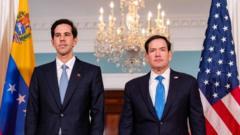
The United States has called on Venezuela to release the remaining political prisoners in the country following a military coup carried out by US-backed forces initiated by President Nicolas Maduro from Caracas on January 3 and transferred him to New York for trial. Although over a thousand political prisoners have been freed since then, a Venezuelan human rights organization reported that at least 322 individuals remain detained. At a meeting with his Venezuelan counterpart Oliver Blanco on Monday, US Secretary of State Marco Rubio emphasized the urgent need to release these detainees and discussed reforms to facilitate holding credible elections.
The US Department of State stated that the meeting also focused on necessary reforms to lay the groundwork for free, fair, and credible elections, a demand championed by the Venezuelan opposition led by Maria Corina Machado, who was awarded the Nobel Peace Prize in 2025. Machado returned to Venezuela on October 25 after nearly a year in exile, where she dedicated her first visit to meeting with relatives of detained political figures.
The background of the crisis dates back to the 2024 presidential election, which the government-dominated National Electoral Council declared won by Maduro despite independent evidence pointing to an opposition victory. The Carter Center, which sent independent observers, stated that the elections "cannot be considered democratic," while a United Nations mission found that the government organized severe repression against opponents and those expressing critical opinions.
Following Maduro's imprisonment, his loyal vice president, Delcy Rodriguez, was inaugurated as interim president with support from the Trump administration, but opposition parties within Venezuela express urgency over the slow pace of required reforms. The US Department of State reaffirmed its commitment to President Donald Trump's plan consisting of three stages: stability and economic recovery, followed by political reconciliation, and finally democratic transition.
Rubio clarified a week ago that Venezuela's electoral infrastructure must be replaced to hold new valid elections, emphasizing that this does not require ten years, five years, or even two years, but must happen quickly according to specific timelines. Meanwhile, Rodriguez stated in a televised speech last week that elections will take place under an "renewed" electoral authority without specifying an exact date. On her part, Machado is pushing for elections in 2027 and proposed a specific day before returning to calling for a vote within the coming year.
Analysis & context
Analysis & Context
From an analytical perspective, this US statement represents a fundamental shift in Washington's foreign policy toward Latin America, moving from mere observation of the crisis to direct intervention to support the political transition. The significance of this step lies in Washington's attempt to break the deadlock that has persisted for years of Venezuelan rule and restore international legitimacy to the electoral institution.
In the broader context, UN reports indicate that the Venezuelan government has practiced severe repression against opponents since the 2024 elections, leading to a deterioration of the humanitarian situation in the country. These violations have contributed to strengthening international support for demands to release prisoners and hold new elections under international supervision to ensure their integrity.
It appears there is increasing tension between the US administration supporting Rodriguez and opposition parties who feel frustrated by the slow pace of required reforms. Machado attempted to reconcile the demand for serious elections with maintaining momentum in international pressure, reflecting the complexity of Venezuela's current political landscape.
Finally, the US decision to pressure Venezuela highlights geopolitical shifts in the region as Washington seeks to reshape the regional landscape away from traditional Russian and Chinese influence in Venezuela.