Sourced fact
The News
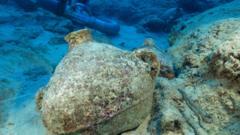
Archaeologists in Turkey have discovered the oldest shipwreck in the world off the coast of Kekova Island in the Antalya region. The ship dates back to the Early Bronze Age, between 4,400 and 4,700 years ago, the same period when the Egyptian pyramids were being built. Researchers found around thirty clay jars (amphorae) on the ship, some still containing remnants of their original cargo.
Professor Hakan Öniz, who led the research team, stated: "The shipwreck lies at the bottom of the sea like a time capsule, carrying valuable evidence of ancient trade." According to the analysis of the amphorae's shapes, Professor Öniz confirmed that the ship dates back to the Early Bronze Age with one hundred percent certainty.
Professor Karen Söder, an archaeologist from Macquarie University in Australia, pointed out that some of the amphorae still contain glossy and sticky residues, which are astonishing. She commented: "The amount and quality of the residues were astonishing."
The research team is now working to identify what the ship was carrying, which could be olive oil, wine, or fruit juices. Research also suggests that the ship was transporting goods to the city of Troy or to the Mycenaean people in Cyprus.
Turkish Culture Minister Murat Süreyya stated that the items retrieved from the shipwreck site will be displayed at the new maritime museum in Antalya when it opens in the coming months. These discoveries are now the oldest shipwreck in the world, surpassing the previous record holder off the coast of Dokos Island in Greece, dating back approximately 4,200 years.
Analysis & context
Analysis & Context
Analytically, this discovery offers a unique glimpse into maritime trade in the ancient world. The ceramic tools found suggest that the ship was transporting goods such as olive oil, wine, or wax. This discovery aids in understanding the development of trade and communication during that period. Additionally, it highlights the risks of sea travel in that era, where natural conditions like strong currents and fierce winds threatened ships. In a broader context, this discovery helps in understanding the history of maritime trade in the Mediterranean and its evolution over time.