Sourced fact
The News
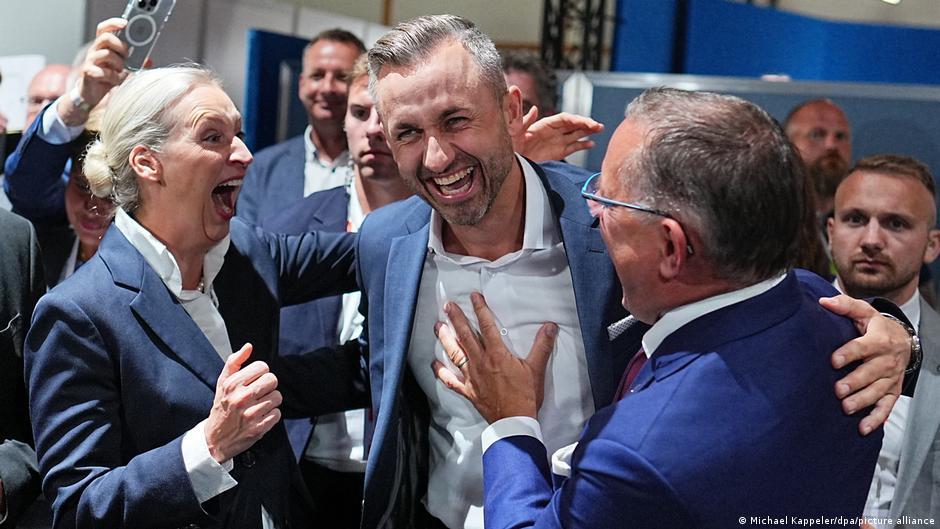
Saxony-Anhalt in Germany witnessed a historic night after the Alternative for Germany (AfD), classified by domestic intelligence as an extreme right-wing party, achieved a surprising victory, sparking significant commotion among journalists and politicians upon the announcement of preliminary results.
The AfD spokesperson clarified that the result represents clear mandates to form a government before Christmas, while current state Chancellor Friedrich Merz from the Christian Democratic Union (CDU) described himself as being replaced by this important electoral win.
Tino Schroppala, one of the AfD leaders, stated that the results were a shock to the head of government, who accused him of unnecessarily increasing tensions with Russia, while admitting he did not expect such a clear defeat after the polls closed.
In contrast, the Christian Democratic Union (CDU) faced an electoral disaster that halved its seats compared to previous elections, where state Chancellor Sven Schulz remained in office despite voter rejection, described by some as political audacity.
Eva von Angern from the Left Party highlighted that these results represent a dark day for the state due to the AfD's strict policies toward refugees, which mandate deportation of asylum seekers whose requests are immediately rejected.
From her side, a representative from The Greens expressed mixed emotions between joy and shock after crossing the five percent threshold, expected not to be achieved, emphasizing that while their electoral success is notable, the inclusion of extreme right-wing parties in government does not warrant premature celebration.
Additionally, Tim Klose, Secretary General of the Social Democrats in Berlin, expressed optimism about the possibility of forming a coalition between major parties excluding any partnership with the AfD to ensure state stability.
Analysis & context
Analysis & Context
Analytically, this decisive victory for the Alternative for Germany represents a pivotal moment in modern German history, where a state governed by traditional parties for two decades has transformed into a battleground threatening democratic stability. The rise of the extreme right, classified by German domestic intelligence as "confirmed extreme right," reflects increasing voter polarization amidst an economic and social crisis, making future government formation extremely complex without either including this party or completely excluding it.
In the broader context, the Christian Democratic Union (CDU) faces an existential challenge after 24 years of continuous rule in Saxony-Anhalt, where its electoral base has collapsed sharply amid expectations that it may not win an absolute majority in the state parliament. This collapse occurs while Federal Chancellor Friedrich Merz suffers from unprecedented popularity decline, exacerbating the political crisis and raising questions about the future of the German federal government and his stance on relations with Russia.
The victories of The Greens and the Left Social Democrats offer hope for forming "center" coalitions that exclude dealing with the extreme right, but the unclear final results of other parties like the Economic Left Alliance (BSW) add another layer of complexity to the political equation. These dynamics indicate that the elections were not merely a change in local power but a sign of deep transformations that could completely reshape Germany's political map in the coming months.