Sourced fact
The News
Ukrainian authorities have accused Russia of attacking relief and recovery efforts in the village of Komysivakh, located near the front line, just two weeks after a fierce attack that killed more than 72 people. Ukraine stated that Russia carried out successive attacks on a humanitarian aid center in the village on November 2, using a massive 3,000 kg air bomb targeting a shelter where residents had taken refuge to escape danger.
Ukrainian Emergency Service (DSNS) officials explained that rescue teams faced multiple Russian strikes resulting in injuries to three police officers, four workers, and two rescue dogs, while five administrative vehicles were damaged. Officials noted that fear of repeated bombing forced workers to periodically halt operations and return to safe locations, raising genuine concerns about the recurrence of attacks on the site.
An Ukrainian intelligence officer from the Security Service (SBU) named Oleksiy stated that rescue vehicles bore clear markings, accusing Russian forces of deliberately destroying humanitarian work equipment. He added that the village's infrastructure and remaining residents are systematically targeted by drones and bombs, describing this as obvious terrorism against civilians to make life in the front line impossible.
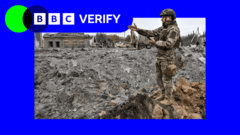
BBC Verify reports confirmed videos showing rescuers screaming "drone" while seeking shelter the day after the first attack, while another team was seen treating a victim at the site. As bodies continue to be recovered from rubble, Oleksiy noted, the Russian Ministry of Defense issued a general statement denying any link between its attacks and specific incidents, reaffirming that it targets energy and transport military facilities in Ukraine without commenting on the situation in Komysivakh.
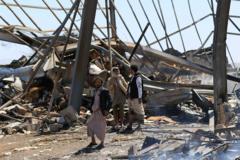
Explosion experts from an arms research firm concluded that the large crater visible in footage matches damage caused by a Russian FAB-3000 bomb capable of destroying ground structures. A former expert at Britain's National Crime Agency confirmed that the scale of destruction aligns perfectly with such a bomb, while artillery wreckage images showed intersections compatible with guidance systems for this type of weapon.
International law experts stated that deliberately attacking rescue workers could constitute a war crime if awareness of the humanitarian nature of the operations exists. Professor Ben Saul noted the attack appears to be either a direct assault on civilians or their civilian property, while Professor Samuel Moyn described targeting rescuers and their equipment as a grave violation of international humanitarian law.
Analysis & context
Analysis & Context
From an analytical perspective, targeting rescue teams and humanitarian equipment constitutes a flagrant violation of international humanitarian law principles protecting civilians and medical and humanitarian workers during armed conflict. International law experts such as Professor Ben Saul from the University of Sydney confirm that deliberate attacks on rescuers or their property constitute war crimes, whether resulting from direct attacks on civilians or indiscriminate random attacks.
In the broader context, documented footage and technical analysis indicate the use of a Russian FAB-3000 bomb weighing 3,000 kg, a weapon capable of destroying both ground and underground structures. Experts like Trevor Pall from Armament Research Services confirm that the crater size at the site perfectly matches damage caused by this type of bomb, reinforcing Ukraine's claims about the nature of the attack and the use of heavy weapons against populated areas.
Komysivakh village lies on a strategic route used by the Ukrainian military for supply transport and evacuation, making it a potential military target despite lacking industrial or military installations. However, destroying the relief center that received aid between 10 AM and 12 PM local time contradicts war rules prohibiting targeting of civilian facilities even when close to active combat lines.
Videos published from body cameras show horrific scenes where police officers hear increasing radio warnings of an incoming attack before forcing residents to flee to underground shelters, only to be shocked by a massive explosion minutes later. This pattern of successive attacks reflects a military tactic aimed at weakening humanitarian will and transforming relief zones into open battlefields.