Sourced fact
The News
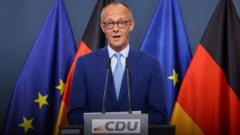
The recent local election results in Germany have caused significant political tension, as Chancellor Friedrich Merz described the defeat of the Christian Democratic Union (CDU) as a "disaster," despite his promises to remain in office. In the northeastern state of Mecklenburg-Vorpommern, the party failed to cross the five percent threshold required to enter the parliament, resulting in its worst performance since World War II according to public broadcasters' estimates.
At the same time, it is expected that the Alternative for Germany (AfD) party will win most votes in the aforementioned state, but this victory does not translate into governance because other parties refuse to work with them. Merz also faces increasing pressure after his approval ratings have declined over the years, with rumors circulating about replacing him mid-term in what is known as a chancellery swap, while there were suggestions that the ruling Christian Democratic Union party in Berlin could lose to the left-wing party (Die Linke).
Alice Feidel, spokesperson for the Alternative for Germany party, clarified that Merz would leave his post very soon after being asked about his duration in power. In contrast, Chancellor Friedrich Merz emphasized the necessity of implementing an economic, customs, and social reform package, stating that these reforms are the "antidote to authoritarian poison" infiltrating German society.
Björn Dröge from the Christian Democratic Union party in Berlin stated that it is correct for Merz to remain in office because he has much work to complete and there is no wasted time to form a new government at the federal level. The spokesperson noted that voters are "impatient" and that expecting all issues to be resolved within one year is unrealistic, believing the chancellor deserves four full years to serve.
Support for the Alternative for Germany party in Berlin rose to around 16% of total votes, while the left-wing party is expected to secure 26% compared to 19% for the Christian Democratic Union party. These results are attributed to the agenda attracting anti-migration and pro-Russia themes, which proved fertile ground in former East Germany, despite branches of this party being classified as extremist—a classification they strongly reject.
Analysis & context
Analysis & Context
Analytically, these election results reflect radical changes in the German political landscape, where the Alternative for Germany party is gaining significant momentum, especially in eastern regions that were previously under communist influence, posing a major challenge to the current coalition government.
In the broader context, Merz faces increasing pressure due to his low popularity and declining party performance, which some describe as having a right-wing agenda on migration issues that failed to reduce AfD support but instead strengthened it among certain voters.
Merz's continued tenure despite electoral losses reveals an internal political struggle: his supporters defend giving the chancellor enough time to solve inherited problems, while opponents argue for swift change, especially with rising popularity of alternative forces.
These elections are pivotal for Germany's future governmental stability, as their results could lead to reshaping political alliances or accelerating toward early elections if the government fails to convince voters of its reform program.