Sourced fact
The News
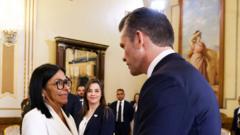
The United States and Venezuela have officially announced the re-establishment of their military relations less than a year after the abduction of Venezuelan President Nicolás Maduro in the capital, Caracas. On Wednesday, the transitional government in Venezuela, led by Delcy Rodríguez, signed a military cooperation agreement with U.S. Secretary of Defense Pete Hegseth. Hegseth described this dramatic shift as Venezuela transitioning from being an aggressive regional threat to a compliant security partner in less than 12 months.
The details of the agreement, which have not been fully disclosed yet, include training for the Venezuelan armed forces, improving their operational equipment, and gaining access to new technologies to address shared threats. This announcement came following Hegseth's visit to the U.S. Embassy in Caracas, where he noted that his presence there would have been impossible a year ago when Maduro was evading justice. Hegseth spoke about the transformation of the security landscape, stating that their response to the challenge was executed through the military operation that led to the arrest of the accused.
The roots of the interruption of military relations between the two countries date back to 2005, when the late Venezuelan president Hugo Chávez suspended them, alleging the presence of U.S. elements spreading rumors about his government. The situation later worsened under Maduro's rule, reaching its lowest point at the end of last year when the U.S. increased its reward for information leading to his capture to $50 million. Maduro and his wife Cilia Flores were captured in a military raid on January 3rd and are currently held in New York on charges of drug trafficking and conspiring to commit torture.
On her part, Delcy Rodríguez described the agreement as exceptionally important for bilateral relations and transforming difficult moments into space for cooperation and mutual benefit. In his comments on ongoing threats, Hegseth warned against drug-addicted criminals who exploit Venezuela as a safe haven and threatened to pursue and eliminate them. The U.S. minister also embarked on a tour of neighboring Colombia after returning from Venezuela to strengthen military partnership with President Gustavo Petro.
Colombian President Gustavo Petro refuted media reports denying the possibility of joint military operations, confirming that any decision would be made in respect for the constitution, laws, and national sovereignty. Hegseth expressed his happiness in tweets that the U.S.-Colombia partnership has become stronger than ever within the framework of the Americas Anti-Gang Coalition. This cooperation falls within the efforts of the American-led coalition against gangs, which includes multiple countries in the Western Hemisphere.
Analysis & context
Analysis & Context
From an analytical perspective, this agreement represents a radical shift in U.S. foreign policy toward Latin America, where Washington is transitioning from a role as observer or enforcer to a direct security partner with transitional governments in the region. This orientation reflects a new U.S. strategy focusing on regional security and combating organized crime rather than engaging in traditional internal political conflicts that characterized previous relations.
In the broader context, the history of tensions between Venezuela and the United States stems from mutual accusations regarding military intervention and espionage, where Chávez accused the U.S. Defense Department of being "a member of a conspiracy against the government" by the American intelligence. Now, the focus is on practical security cooperation to address cross-border threats such as drug trafficking and arms flows, fundamentally changing the nature of regional alliances.
Furthermore, Hegseth's visit to neighboring Colombia confirms that this military cooperation is not isolated but part of a broader regional strategy involving other countries in Latin America working within an American anti-gang coalition. This step is considered a continuation of U.S. policy aimed at enhancing regional stability by integrating different factions into a unified security framework under the umbrella of the American-led coalition.