Sourced fact
The News
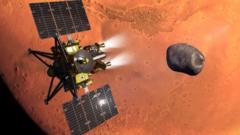
Japan has launched a spacecraft bound for Mars' moon Phobos, marking the first mission aimed at collecting samples from a Martian moon and returning them to Earth. According to the Japan Aerospace Exploration Agency, the spacecraft will reach Phobos in August 2027, where it will study the moon and gather samples of its regolith for analysis in terrestrial laboratories.
The Martian Moon eXploration (MMX) mission aims to unravel the mystery of Phobos' formation. Professor Sarah Russell from the Natural History Museum noted that this mission is "ambitious and exciting." Professor Russell added that no successful mission has yet been sent to Phobos to collect samples and bring them back to Earth.
The MMX mission is distinguished by its close-up study of Phobos, deploying a small rover on its surface to collect regolith samples. Despite Phobos' small size, with a diameter of approximately 20 km, the MMX mission faces significant challenges in landing on its surface. Professor Russell explained, "There is not enough gravitational pull on Phobos to assist with landing, but its proximity to Mars increases the complexity."
The spacecraft will collect Phobos' regolith samples using a robotic arm, and these samples will be sealed in a small capsule that will return to Earth in 2031, landing in the Woomera Desert in Australia. Professor Russell noted, "It will be clear whether the samples are the result of a large impact or captured objects from the outer solar system."
The samples collected aim to resolve the mystery of Phobos' formation, with two possible theories: Phobos could be the result of an early impact on Mars that generated these moons, or it could be wandering asteroids captured by Mars' gravity from the outer solar system. Scientists hope that by analyzing these samples, they can determine which theory is more accurate.
Analysis & context
Analysis & Context
Analytically, the Phobos mission is a significant step in space exploration, providing new data on Phobos' composition and formation. Scientists believe Phobos could be the result of an asteroid impact on Mars or captured asteroids within Mars' gravitational field. The samples collected will provide clear answers to these questions. Additionally, the mission offers a unique opportunity to study Mars' history directly through samples that may have traveled from Mars' surface to Phobos. In a broader context, the Phobos mission faces significant technical challenges, such as landing on a small moon like Phobos, making it an exciting and innovative mission.