Sourced fact
The News
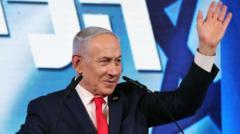
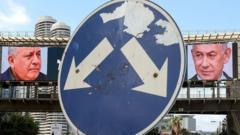
Israel is currently facing a severe political stalemate, where neither the current Prime Minister Benjamin Netanyahu's coalition nor his main rival Gad Eizenkot's bloc has secured the parliamentary majority needed to form a government, according to BBC News estimates after 85% of the votes were counted. In this context, it appears that one of the leading parties will have to break its election promises, making new elections the most likely outcome if negotiation attempts fail.
BBC News responded to a question about the possibility of forming a national unity government led by Netanyahu, noting that this would require Eizenkot to abandon his core platform of ousting Netanyahu, especially after the latter recently called for his political retirement. The source also mentioned that Netanyahu might try to persuade Eizenkot's Yashar party to join Likud by replacing current hard-right Jewish religious allies with others like Israel Beiteinu for Lieberman and Bayit Veyad for Ben-Yitzhak. However, it was also noted that rising tensions with Iran could push political leaders to put aside their differences and work together.
In another scenario proposed by BBC News, a coalition led by Eizenkot including Arab parties could be formed, representing a sovereign shift in Israeli politics given that most Jewish parties had previously ruled out working with these blocs. The Arab parties achieved remarkable results by securing record seats thanks to unprecedented voter turnout among Arabs, though this coalition would be extremely fragile, especially regarding Gaza and the West Bank issues.
The third scenario involves forming a majority led by Netanyahu by persuading hard-right parties in Eizenkot's bloc to join his alliance, where he might try replacing ultra-Orthodox Jewish parties with others like Israel Beiteinu for Lieberman and Bayit Veyad for Ben-Yitzhak. If all these attempts fail, the default outcome would be holding new elections, which Netanyahu might view as fulfilling his political vow while remaining interim Prime Minister until the next election date.
Analysis & context
Analysis & Context
From an analytical perspective, this political stalemate represents a historic turning point in the Israeli landscape, where for the first time since 2019, Israel has not continued holding five consecutive elections as happened between 2019 and 2022. This deep hesitation reflects the social and political divisions the state is experiencing, particularly with the growing strength of Arab parties that have long felt marginalized within the Israeli political system.
In the broader context, BBC News reports indicate that Arab voter turnout was driven by a strong desire to end the rule of the hard-right coalition, described by many as the most extreme in Israel's history. This unexpected turnout highlights the profound demographic and political changes the country is undergoing, where Arabs represent about one-fifth of the population and identify themselves as Palestinian citizens of Israel.
Regional background also plays a pivotal role in this equation, as rising tensions with Iran and US international pressure could be the decisive factor pushing political leaders toward consensus or, conversely, toward division. Netanyahu's attempt to maintain his alliance with ultra-Orthodox Jewish parties despite internal opposition reflects a complex political strategy aimed at ensuring his stay in power even under difficult circumstances.
Finally, the possibility of returning to new elections raises questions about the stability of Israeli democracy and its ability to overcome political crises through dialogue rather than repeatedly resorting to ballot boxes. This scene shows how the Israeli political system faces existential challenges requiring creative solutions to avoid institutional collapse or continuing exhausting election cycles that have negatively impacted government and economic performance in the country.