Sourced fact
The News
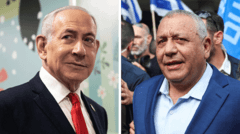
Negotiations are currently underway between Israel's interim Prime Minister Benjamin Netanyahu and opposition leader Gadi Eisenkot in an attempt to break the political deadlock left by last month's elections.
Netanyahu's bloc won 53 seats in the October election, while Eisenkot's bloc, composed of four parties, secured 48 seats, leaving neither with an absolute majority in the 120-seat Knesset.
On Saturday, Netanyahu proposed a national unity government system with alternating presidency, stating his willingness to accept serving as Eisenkot's deputy first while he holds the position of Vice President at the start of the term.
Speaking on X, Netanyahu said that his responsibility as a leader obliges him to ignore everything, including the principle of the largest party, clarifying that he agrees to serve Eisenkot as the first Prime Minister while he would take on the role of Deputy President.
In contrast, Eisenkot called on Netanyahu to engage in "real and accelerated negotiations," especially after the right-wing Likud party accused him of stalling coalition talks to force parties into holding new elections.
Israeli President Isaac Herzog noted that he consulted all parties during the week following the October 27 elections but tasked Eisenkot with forming a government within 28 days.
Eisenkot faced difficulties in forming a coalition to exclude Netanyahu due to opposition to working with Arab parties and the difficulty of reaching an agreement with supra-ethnic parties that won a record 19 seats.
He also clarified that negotiations would proceed based on a "detailed proposal" he sent to Netanyahu last Sunday, which has received no response so far, while Netanyahu described the situation as posing an existential threat requiring a government capable of dealing with it.
Analysis & context
Analysis & Context
From an analytical perspective, this scene represents a repetition of Israeli political reality where no party has ever won an absolute majority in the Knesset, making coalition governments the prevailing norm rather than single-party rule. The period between 2019 and 2022 witnessed one of the most politically fragmented periods in Israeli history, with five separate elections held while Netanyahu and his rivals repeatedly struggled to cooperate in forming a stable government.
In the broader context, Netanyahu faces additional challenges related to the position of Arab parties that secured a record 19 seats following increased turnout among Arab voters; despite their potentially decisive influence, all Jewish parties except one had pledged before the election not to work with these parties to form a government. Moreover, difficulties in reaching agreements with hardline religious parties and the refusal to cooperate with Arab parties hindered President Isaac Herzog's efforts to form a coalition excluding Netanyahu, despite some progress made in reaching agreements with two parties.
The role of state president Isaac Herzog also stands out; he consulted all parties during the week following the October 27 elections and then tasked Eisenkot with forming a government within 28 days, reflecting the constitutional role of the president in managing government formation crises when traditional talks fail.