Sourced fact
The News
The International Court of Justice in The Hague, Netherlands, opened the trial of former Filipino President Rodrigo Duterte on Monday, charging him with committing crimes against humanity during his ruthless campaign against drugs that claimed thousands of lives. This event marks a historic turning point, opening a chapter of one of the most violent and divisive periods in Philippine history. Eighty-one-year-old Duterte faces three charges of murder and attempted murder related to illegal police operations.
The scene is marked by sharp political polarization between supporters of the former president who view his transfer to the international court as an act of treason against national sovereignty by the current government led by Ferdinand Marcos Jr., and victims' families who see in this trial a form of justice and public recognition of their suffering, which the state ignored for two decades. Reports indicate that Duterte withdrew the Philippines from the court's jurisdiction in March 2019, but the International Court of Justice affirms its jurisdiction over crimes committed prior to that date and where the state failed to conduct a serious investigation.
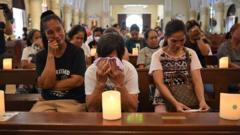
Eyewitnesses and victims' associates describe their tragedies with painful detail. Leonelia Ignacio recalls crying upon remembering her daughter Primissa's disappearance seven years ago after she was seen in surveillance footage being dragged into a police car before the police denied taking her. Randy Delos Santos, brother of Kian who was shot dead by police in 2017, notes that his investigation was extremely difficult without official assistance, but he thanks the court for its attention to widespread human rights violations confirmed by evidence.
Details reveal the nature of the campaign, which included "tupung" or door-to-door raids often ending with suspects killed under the claim of resisting arrest, along with the use of police death squads or heterogeneous drug gangs. Duterte has stated on occasions his desire to kill 32 people every night after 32 were killed in a single night in Bulacan province, and at one moment compared himself to Adolf Hitler, while denying any official policy of killing and insisting deaths resulted from excessive police enforcement.
The case remains surrounded by political controversy. Duterte was flown to the Netherlands on a private jet after returning from Hong Kong last March, a move his supporters condemned as a political maneuver by Marcos's administration to weaken them. Nevertheless, Duterte's anti-drug policies remain popular in large parts of the country, making accountability for thousands of victims difficult amidst angry or sarcastic reactions on social media from victims' families.
Analysis & context
Analysis & Context
Analytically, Duterte's trial represents a historic precedent as he is the first Asian leader to be tried at the International Criminal Court, and if convicted, will be the first former head of state found guilty there. This case reveals the gap between the political popularity of harsh suppression policies and the tragic human reality left behind by "tupung" (door-to-door raids) and irregular death squads that killed suspects under the pretext of resisting arrest.
In a broader context, the current situation in the Philippines reflects sharp political polarization between the Duterte and Marcos families, who previously allied and then split amid bitter name-calling. The Duterte family views the transfer to The Hague as a political maneuver by Marcos's administration to weaken them. Nevertheless, Duterte's anti-drug policies remain popular in large parts of the country, making accountability for thousands of victims complex and difficult for local public opinion.
The report indicates that the international court retains jurisdiction over crimes committed before the Philippines' withdrawal in March 2019, considering itself a court of last resort due to the state's failure to investigate and prosecute those responsible for mass killings. Witness testimonies also point to death squads employing people under pressure or threat, adding an ethical and legal dimension of complexity to the case, which remains controversial to this day.
It offers thousands of victims of Rodrigo Duterte's anti-drug campaign the accountability denied since the killings began.