Sourced fact
The News
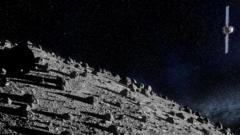
According to BBC News, a spacecraft belonging to the European Space Agency (ESA) has arrived at an asteroid to investigate the damage caused by a unprecedented collision in space. This mission was experimental, aimed at testing our planet's defenses against space rocks heading toward Earth; the asteroid posed no real threat but served merely as a target for the experiment.
According to BBC News, the American NASA spacecraft deliberately collided with the asteroid in 2022 to alter its natural trajectory, but it shattered completely upon impact. After four years, the European Hera mission is now sweeping the scene to assess the final results of the collision, with the first images of the site scheduled for release later this Wednesday.
Patrick Michel, ESA's Hera mission principal investigator, stated: "Hera is a type of Colombo inspector that returns to the accident scene to investigate what the result of this impact was." The mission aims to answer many scientific questions regarding the state of the asteroid after the collision, including determining the size and depth of the crater it may have created or whether its surface was completely reshaped.
Analysis & context
Analysis & Context
From an analytical perspective, this experiment focused on a pair of asteroids consisting of a larger body called Didymos, with a width of 730 meters, and a smaller body called Dimorphos, with a width of 150 meters, orbiting around it. The results of the first impact showed that altering the trajectory of the small asteroid was indeed possible; its orbital period around the larger body decreased by 33 minutes after the collision, which occurred at an immense speed of 22,000 kilometers per hour.
In the broader context, these missions represent part of global efforts to gather comprehensive information about space rocks to prepare humanity to deal with any potential threat from the cosmos. Scientists indicate that large asteroids exceeding one kilometer in size could cause global destruction, while medium-sized asteroids like Dimorphos could destroy an entire city if they were to impact Earth.
Additionally, a new mission is scheduled for launch in 2027 using a space telescope called the NEO Surveyor to track potentially hazardous asteroids. There are also plans for future visits to another asteroid called Apophis, which will pass safely above Earth's surface instead of colliding with it in 2029 as previously believed.
Caroline Ernst from the Johns Hopkins Applied Physics Laboratory added: "The reward for us is that there are far fewer potential threats in the solar system than there were millions of years ago, but there are still objects present." Two spacecraft will visit asteroid Apophis, including NASA's OSIRIS-REx mission and the joint Ramesses mission between the European Space Agency and JAXA (the Japanese space agency).