Sourced fact
The News
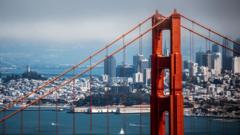
San Francisco is currently experiencing an economic renaissance driven by the surge in the artificial intelligence sector, transforming the city from a recessionary state caused by remote work during the pandemic into a magnet for major corporations and skilled employees. This increase is clearly highlighted by rising rents and home prices, decreased vacancy rates in offices, and the widespread presence of mysterious AI advertisements on buildings and buses in the city streets.
The emergence of leading companies like OpenAI and Anthropic, both headquartered in San Francisco, serves as the main driver of this expansion; recently, Anthropic listed its shares on the NASDAQ stock exchange in New York. Data from the International Monetary Fund indicates concerns about a significant bearish correction in AI stocks that could lead to a sharp decline in investments, raising questions about the ability of leading American companies to generate sufficient revenue to justify their massive spending as cheaper and more efficient models emerge.
Regarding the reactions of workers in this sector, one anonymous employee admits that a market correction is entirely possible but believes that the existential threat AI might pose to humanity is the greater concern compared to market crashes. Another employee working for one of the city's largest companies expresses confidence in an impending "paper house" collapse and its impact on him, yet he is not worried about it because he sees that uncontrollable matters require little preemptive anxiety.
Studies indicate that 60% of venture capital directed at American AI companies between 2023 and 2025 went to firms located in San Francisco, significantly outperforming companies in Silicon Valley, located south of the city. Nevertheless, Jeff Bellasario, Executive Director of the Bay Area Economic Institute of the Regional Economic Council, explains that employment is not as substantial as perceived given the amount of venture capital and the establishment of new companies, which may mitigate the severity of any economic downturn's impact on direct jobs.
Ed Igan, an economic expert in the City and County of San Francisco, notes that while current times are good for technology in the city, they are not witnessing massive growth in total tech jobs. Meanwhile, Professor Enrico Moretti estimates that the city still lacks approximately 35,000 jobs compared to pre-pandemic peaks. He attributes this to AI company spending going primarily to data centers and computing power located outside the San Francisco Bay Area, making the city the brain of growth rather than its muscles.
Despite this, Moretti warns that any major correction could be very painful for the city due to its spillover effect on service sectors such as restaurants, retail, and dog-walking services run by Lauren Goldbus. However, Igan believes the economy was not screaming during this boom, so he does not expect it to stop if spending slows down, considering it merely a "spasm" or expected stumble rather than a fundamental correction of the urban economic trajectory.
Analysis & context
Analysis & Context
From an analytical perspective, the economic focus of the AI surge in San Francisco differs fundamentally from previous waves of technological expansion; companies are investing primarily in data centers and computing power located mostly outside the San Francisco Bay Area. This means the city functions as the brain of the tech project while the physical body of operations resides elsewhere, limiting the number of direct jobs compared to the massive scale of investments.
In a broader context, economic analyses suggest that the impact of any sharp correction might be less severe than some fear because the AI sector does not attract as many employees as occurred in the 1980s and 1990s. However, indirect repercussions on service sectors like restaurants, retail, and dog-walking services could be extremely painful if hiring slows or leads to layoffs.
Economists add that San Francisco's recovery does not rely exclusively on technology; healthcare and tourism sectors contribute to diversifying the city's economic base. The city's efforts to improve safety and cleanliness at the downtown shopping center have helped attract tourists back, providing a layer of protection against potential shocks in the technology sector.
Finally, economic officials believe that any decline in AI spending will be merely a small "nudge" in the city's economy rather than a fundamental correction of its economic trajectory. Experts recommend that local government encourage growth in non-tech sectors and maintain financial reserves as precautionary measures to ensure the city's resilience against global market fluctuations.