Sourced fact
The News
The scheduled football match between Ireland and Israel in the UEFA Nations League 2026-27 is facing widespread anger amid acute political tensions related to the ongoing war in Gaza, where authorities expect the match to proceed according to the schedule despite escalating demands for its cancellation.
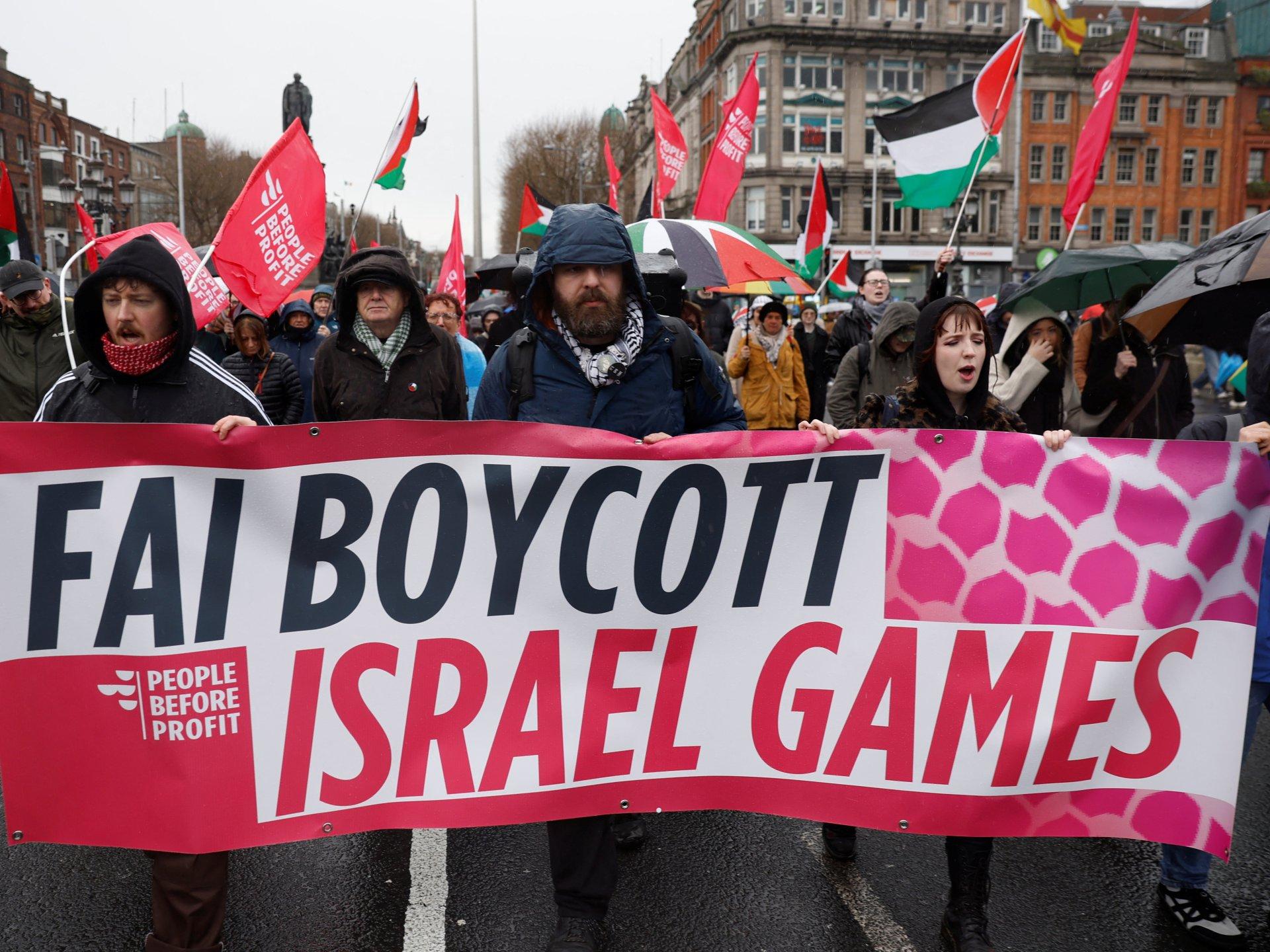
Both teams have been assigned to the same group in the UEFA Nations League after the European sports governing body approved the tournament fixture list in February last year, prompting sharp reactions from Irish fans and players who condemn Israel's war on Gaza and call for boycotting the match at any cost.
The two teams are preparing to play two matches within eight days amidst strained political relations; the first match, which Ireland considers an "away game," will be held at Nagardí Stadium in Debrecen, Hungary, on September 27, while the second match, considered a "home game" for Israel, will take place in Serbia on October 4.
It is worth noting that both countries are members of UEFA and participate in European classification tournaments and promotion competitions; Ireland and Israel were drawn together into Group B, Group 3, along with Austria and Kosovo under the initial round system where each team plays against every other team twice.
Since confirming the match on February 12, the Irish Football Association has faced immense pressure, as prominent Irish players and public figures joined a campaign calling for a walkout after a UN report in June 2025 confirmed genocide in Gaza.
David Curley, President of the Irish Football Association, stated that the national team has no choice but to fulfill its commitments to avoid harming Ireland's long-term sporting interests, while head coach Haimar Halgrimsson replied that the team is playing against genocide, not with it.
In response, the Israeli Football Federation responded to Head Coach Halgrimsson's statements by saying they are not playing with ignorance and contradiction but against the coach who embodies these traits, while Irish Prime Minister Michael Martin defended the coach, describing Israeli comments as unacceptable.
Public opinion polls indicate that the majority of the Irish public prefers not to participate in the matches; a poll conducted by the Players' Union showed that 63% of respondents do not want to play against Israel, while 71% of the general public support the FA's refusal of the match according to an Ireland Mirror newspaper poll.
Bohemian Football Club in Ireland, which adopts a pro-Palestine stance, urged the federation to withdraw, and its sporting director Pat Fillion said the opportunity is ripe to be the first country to stand against this crime, while club officials accused the federation of procrastination despite public awareness of potential consequences.
Analysis & context
Analysis & Context
From an analytical perspective, this controversy emerges as a rare case where sports and politics intersect directly at the heart of UEFA. Reports confirm that UEFA members such as Ireland and Israel are committed to participating to improve their international standings and advance to higher levels, despite deep political divisions currently separating the two nations.
In a broader context, opinion polls conducted by local organizations and independent bodies indicate that the majority of the Irish public leans toward boycotting the match, reflecting a shift in public awareness regarding the Palestinian cause. Additionally, Prime Minister Michael Martin's remarks about the difficulty of separating sports from politics highlight the diplomatic challenge faced by FIFA in handling such critical cases.
It is also worth noting that hosting matches outside the national territories of the warring parties, such as Hungary and Serbia, serves as a technical compromise to overcome security and political restrictions preventing Israel from hosting since September 2023. This arrangement reflects UEFA's attempt to maintain tournament continuity despite massive political and social pressures facing it.
Finally, reciprocal reactions between Irish and Israeli officials reveal the depth of current divisions; Ireland's coach described the match as being against genocide, while Israel responded that the coach embodies ignorance and misinformation. These tensions indicate that football has become a new arena for expressing political positions amid escalating global crises.