Sourced fact
The News
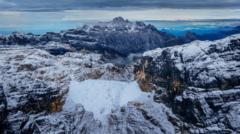
Human-induced global warming has caused the melting of "eternal" snows covering the peaks of the Supraman Mountains in Papua, Indonesia, where the ice area has shrunk from approximately 1,900 hectares in the 19th century to just about 16 hectares today. Estimates indicate that the remaining snow around Puncak Jaya will disappear completely within the next two years, representing a devastating loss for scientists and local communities who share deep spiritual ties with these mountains.
Marija Šapaka, a Czech glaciologist who visited the region last March, explained that Papua's glaciers are unique because they are isolated from other ice systems by thousands of kilometers and represent the last remnants of tropical glacier between the Andes and the Himalayas. She added that these snows provided a historical climate record through ice core samples that preserved information about atmospheric conditions and changes in warm ocean waters, but this archive is now disappearing before scientists can study it fully.
Danish researcher Klaus Thiemann stated that the ice area has shrunk by 95% between 2000 and 2025, adding that the disappearance of what was once called "eternal" evokes strong emotional reactions among people. He pointed out that the retreat of glaciers in Papua, located 450 kilometers south of the equator, is conclusive evidence of global temperature rise, leading to a shift from snowfall to rain even at high altitudes.
Environmental activist Amungme Adelina Kom asked: "How would Muslims feel if Mecca were destroyed? And how would Catholics feel if Rome or Vatican City were destroyed?" She noted that the destruction of the Nimanggawi mountains makes people feel the same way their communities do. She confirmed that local communities lose an important source of spiritual strength when sacred mountains, forests, and ancestral places are disturbed, comparing it to pulling a tree's roots, which deprives it of its foundation.
The glaciologist also noted that local factors such as cloud cover and mountain topography affect the rate of melting, but the main driving force is global warming caused by burning fossil fuels. She added that the disappearance of glaciers removes both a biological habitat and an important part of cultural landscape, while the region has undergone radical transformations due to the discovery of copper and gold deposits in the 20th century, altering the natural and social landscape.
Analysis & context
Analysis & Context
From an analytical perspective, the disappearance of glaciers in Papua represents an exceptional case that highlights the sensitivity of tropical regions to climate change compared to usually studied polar areas. While snow-capped mountains exist in the Andes and Himalayas, Papua retains the last remnants of tropical glacier between these two massive systems, making it a vital natural laboratory for studying the impacts of global warming on unique ecosystems.
In a broader context, the impact of this melting extends beyond environmental concerns to deeply affect the cultural and spiritual dimensions of the region's indigenous inhabitants who have maintained strong spiritual connections with these mountains over generations. For the Amungme people, the mountain is not merely a rock formation but a moral and religious symbol representing integrity and purity; activists compare the destruction of these peaks to destroying Mecca or Vatican City from an emotional standpoint.
The region is also experiencing rapid economic and social transformation since the discovery of massive copper and gold deposits in the 20th century, leading to the development of extractive projects that have altered the natural landscape and caused long-standing social conflicts. Local communities face a painful paradox between job opportunities and the economy brought by these projects versus environmental degradation and the loss of traditional lands relied upon by generations of indigenous people.
Finally, scientists point out that geological records preserved in ice core samples represent a unique historical archive for the region's climate and the tropical Pacific Ocean—an archive now disappearing faster than researchers can study it fully before losing its scientific value for future generations.