Sourced fact
The News
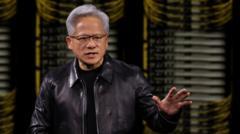
The case of former NVIDIA CEO Jensen Huang, whose standing has declined due to allegations regarding his closeness to a Chinese woman with alleged ties to the Chinese intelligence apparatus, represents a perilous turning point in Washington-Beijing relations ahead of a summit between President Donald Trump and his Chinese counterpart Xi Jinping.
Chinese officials fear that these unproven accusations could be used as a pretext to strengthen U.S. restrictions on exporting advanced chips, potentially disrupting diplomatic efforts to stabilize trade following the tariff war that has wreaked havoc on relations between the two countries.
China's Ministry of Foreign Affairs stated that allegations regarding secret clients are "defamation" against China and called on the United States to stop fabricating espionage narratives to justify imposing a technological siege, while Beijing confirmed that close communication between leaders continues despite rising tensions.
This scene unfolds as the Trump administration has introduced new restrictions on Chinese companies using data centers in third countries to train AI models, sparking debate in Washington about the administration's readiness to ease security restrictions.
Previously, relations between the two countries deteriorated sharply after the "surveillance suit" incident in 2023, which led to the cancellation of diplomatic visits and created a climate of mutual suspicion; effects similar to this are feared with the Huang case if escalation is not contained.
Both sides hope that the summit will not turn into a discussion about intelligence concerns and technological control but rather focus on trade and investment, especially since Beijing retains powerful counter-tools such as its dominance in rare earth metals used in military and civilian industries.
Analysis & context
Analysis & Context
From an analytical perspective, advanced computer chips have been a primary battlefield in U.S.-China competition for years because they are essential for developing artificial intelligence, supercomputing, and military technologies. Many in the United States view these chips as a national security issue that could enhance Chinese military and surveillance capabilities, while Beijing sees restrictions as an attempt to contain its rise, making any scandal like this likely to lead to further restricting China's access to U.S. technology.
In a broader context, Beijing and Washington have been seeking to stabilize relations for a year after the tariff war that was likened to a commercial stoppage; approval for the sale of NVIDIA H200 chips at the end of 2025 served as evidence of a search for areas of cooperation despite growing competition. However, history teaches that security scandals rarely remain confined to the world of intelligence, as happened with the surveillance balloon incident in 2023, which led to the cancellation of the U.S. Secretary of State's visit and a sharp deterioration in communications.
Furthermore, the summit in Shanghai is a symbolic choice to showcase Beijing's ambitions in artificial intelligence and advanced manufacturing, where China has options for retaliation such as its dominance over rare earth metals used in electric vehicles, smartphones, and military devices. Analysts warn that technological restrictions could trigger a cycle of retaliation where each party pushes its strongest economic tools, changing the direction of relations from engagement to mutual suspicion.