Sourced fact
The News
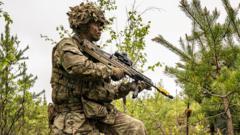
The United Kingdom and France are preparing to lead a major military exercise in Poland this month to test the capability of an international force that could be deployed to Ukraine should a peace agreement be signed. The exercise, known as "Kvalia," involves nearly 3,000 military personnel from twelve European nations and is scheduled to take place between November 9 and November 22. Its primary objectives include simulating the transport, protection, and supply of troops within Ukrainian territory, as well as testing command and control mechanisms to ensure effective joint operations among soldiers from different countries.
Western officials have clarified that any force deployed to Ukraine will not participate in offensive operations, nor will it engage in peacekeeping or ceasefire monitoring missions. Furthermore, this force will not operate under NATO command or on the front lines; instead, it will be present to provide reassurance and assist Ukraine in rebuilding its armed forces. Western officials also denied that this force is merely part of a hypothetical plan, affirming that it is a real, capable, and ready-to-deploy contingent, as previously stated by British Defence Secretary Wes Streeting.
The exercise includes participation from soldiers of the United Kingdom, France, Belgium, Estonia, Germany, Lithuania, the Netherlands, Poland, Spain, Sweden, and Turkey. Turkey will lead the maritime mission aimed at clearing mines in the Black Sea to facilitate the resumption of trade. The Royal Air Force will contribute 300 personnel and two "Typhoon" aircraft to simulate how commercial aviation can be reassured once Ukrainian airspace is reopened following the end of hostilities.
Lt. Gen. Tam Pateman, commander of the multinational force in Ukraine, stated that this exercise represents a significant step toward converting political commitments into verified military readiness, reflecting the serious commitment of alliance nations seeking long-term security and stability for Ukraine. However, Western officials confirmed they cannot comment on the final composition of the force that might be deployed if fighting stops, noting that contributions will depend on each country's political circumstances and individual decisions after the cessation of combat operations.
It is worth noting that while the United States participated in discussions regarding this plan, it will not contribute militarily to the mission. Russia has expressed opposition to the presence of foreign troops in Ukraine; former President Vladimir Putin previously considered such forces as legitimate targets. Moreover, there are no indications of Russia's willingness to end the war, which remains a major obstacle to activating this security arrangement that European nations have been studying since last year as part of long-term security guarantees.
Analysis & context
Analysis & Context
From an analytical perspective, these exercises represent a strategic shift in European security policy, moving beyond merely providing military aid to planning for the deployment of permanent or semi-permanent forces in the conflict zone. This development indicates that Western allies are beginning to translate verbal political commitments into tangible military preparedness, while attempting to balance reassuring Kyiv with alleviating Moscow's fears regarding the expansion of foreign military intervention.
In a broader context, the training of Ukrainian troops on drone warfare remains an interesting point of interest, as well-trained Ukrainian soldiers have become sought after for training NATO forces rather than the other way around, reflecting a shift in the military expertise balance in the region. Additionally, Turkey's leadership role in the maritime mission highlights the importance of multi-party partnerships that transcend traditional NATO frameworks to include countries like Turkey, which possesses specific strategic interests in the Black Sea.
The lack of clarity regarding detailed rules of engagement if international forces are attacked remains a weakness in the plan, as Western officials have refused to clarify rules of engagement despite affirming their ability to defend themselves. This leaves room for ambiguity about the nature of expected military responses in various conflict scenarios.