Sourced fact
The News
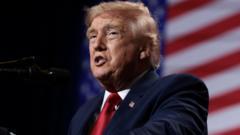
US President Donald Trump declared during his official visit to Ireland that he desires a united Ireland, causing widespread shock in Ireland and its British bloc despite uncertainty over whether this represents a new policy or merely an offhand remark.
Mike Mulvaney, the former special envoy for President Trump to Northern Ireland, stated that these remarks do not represent a shift in US foreign policy nor signify a change in commitment to the Good Friday Agreement. Democratic representative Brendan Boyle also confirmed bipartisan support for the agreement and the unlikelihood of altering this stable position.
Although political elites agree with Trump's observation that unification will eventually occur, the United States will not immediately push an agenda for forced unification. The president repeating such sentiments before an invited audience at the US Embassy suggests he recognizes having opened a complex file during his first press conference.
Trump's sermon, lasting twice the announced duration, drifted significantly from the topic of Irish business to address domestic US issues like illegal immigration and defense production. He also reiterated criticisms of Britain regarding its support for military operations in Iran, reflecting his known style of frequently changing topics during speeches.
The targeted audience is likely Irish-American voters, comprising 10% of the population who may sway between parties before the mid-term elections scheduled for November. While President Bill Clinton secured support from this group through peace process promises, the political landscape has changed with increased polarization and no signs of recent change.
Irish leaders hope that tomorrow's public discussion will focus on a golf game at the Golf Club, avoiding the sensitive political issues raised by the US president.
Analysis & context
Analysis & Context
Analytically, Trump's statements regarding Irish unification raise deep questions about the priorities of the new US administration in handling sensitive international issues. While some analysts view these remarks as mere impulsive reactions during the press conference, they indicate special attention from the US president to matters concerning Irish and American identity.
In a broader context, a united Ireland is a historically complex issue that transcends traditional geographical and political borders, where the Good Friday Agreement remains the cornerstone of regional stability and the balance of power between Britain and Ireland. This agreement has played a pivotal role in ending the long conflict in Northern Ireland and ensuring the rights of all parties involved in the region.
Additionally, the approaching US midterm elections in November form an important factor in understanding Trump's motivations, as the Republican Party seeks to regain control of Congress and avoid significant losses resulting from current presidential policies. Trump may attempt to target independent Irish-American voters who could be influenced by his stance supporting Irish unification in an effort to win their votes.
Finally, political changes in both the US and Ireland make this issue more complex, as the political environment has become more polarized and competitive than in the past. Irish leaders expect public discussion to focus on sports and entertainment matters rather than sensitive political issues that could spark widespread debate among peoples.