Sourced fact
The News
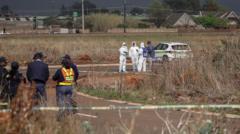
Two women have been convicted in South Africa for the intentional murder and deception regarding justice concerning a woman's body found half-naked in "Parkdown," east of Johannesburg. This is the latest of nine recent murder cases that have reignited debate over levels of gender-based violence in the country.
The Acting Police Commissioner, Colonel Bowling Dimban, stated that his forces are working tirelessly to collect justice from those responsible for these nine cases. Meanwhile, Deputy Police Commissioner Colonel Thibelo Mozekile described the arrest of the criminals as a "breakthrough" under pressure to resolve a wave of murders that included dumping victims' bodies on the roadside.
A police spokesperson noted that the man who was arrested was released without charge, while Mozekile clarified that an analysis team is working hard to determine whether there are links between all these cases, pointing out that the murder of "Jabuli Ntimba" appears to stem from a crime arising from a potential relationship such as a love triangle.
South Africa remains one of the countries with the highest rates of gender-based violence in the world, where Human Rights Commission statistics indicated that approximately six women were killed daily on average between April and June of this year.
These horrifying discoveries have sparked national alarm over the scale of the problem and increased feelings of insecurity among many women, while investigations continue to determine whether all deaths are linked or if a serial killer is responsible.
Analysis & context
Analysis & Context
From an analytical perspective, this incident reignites ongoing debate about levels of gender-based violence in South Africa, which ranks among the highest globally in this field. Official statistics show that the country also suffers from extremely high murder rates; recent estimates from the country's Human Rights Commission indicated that six women were killed daily on average between April and June of the current year.
In a broader context, these horrifying discoveries have heightened feelings of insecurity among many women within society, prompting authorities to work more seriously to uncover the truth behind these crimes. Although police statistics do not always specify the gender of victims, the nature of these crimes clearly indicates the continuation of systematic violence against women in the country.
This situation underscores the urgent need to strengthen legal and social protection mechanisms that support women and provide a safe environment free from daily threats and assaults. It also highlights the necessity for security institutions to collaborate with civil society to address the roots of this problem, which threatens local community stability.
Finally, the ongoing investigation into these cases confirms the authorities' commitment to solving these crimes and delivering justice to victims and their families, despite significant challenges they face in identifying the perpetrator or perpetrators responsible for this human tragedy.