Sourced fact
The News
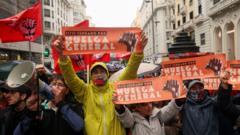
Spain witnessed widespread unrest in transport and public services sectors during the first general strike in 14 years, in response to a call by major trade unions demanding affordable housing and addressing rising living costs. BBC News reported that major demonstrations were scheduled for Madrid and Barcelona, where traffic halted on several major routes in key industrial centers such as northeastern Catalonia.
Pepe Alvarez, head of the major workers' union UGT, stated that the strike achieved great success with "huge" participation, while Unai Sordo from CC OO union confirmed attendance was "very significant." Conversely, the Spanish Cooperative Organization criticized the turnout as "low and unequal," varying by region and sector.
The roots of this strike trace back to widespread protests against affordable housing and rising prices following the eviction of Marisarmen Abascal in her Madrid apartment at age 87, where she had lived for over seven decades. This triggered a sharp collapse in capital rental rates, with the average cost of a 50-square-meter apartment reaching 1,170 euros monthly against an average salary of approximately 2,460 euros.
Prime Minister Pedro Sanchez, leader of the Socialist Party, called on workers to demand their housing rights, asserting the strike is not about labor issues but political matters linked to early parliamentary elections scheduled for November 29. Meanwhile, the People's Party led by Alberto Nunez Feijo accused the government of exploiting the strike for electoral gains.
Analysis & context
Analysis & Context
From an analytical perspective, this event represents a political and social turning point in Spain, combining traditional labor protests with acute social issues like the housing crisis that has sparked widespread public anger. Data indicates a 7.5% electricity outage rate suggests high public support compared to the previous strike where consumption dropped by 15%.
In the broader context, these protests indicate growing tension between the coalition government and the conservative People's Party, especially with parliamentary elections approaching that may determine the country's future. The strike appears to reflect deep dissatisfaction among ordinary citizens facing difficult economic conditions amid rising prices and declining purchasing power.
The role of trade unions as influential political forces in the Spanish landscape is also highlighted, where these unions use strikes as tools to influence public opinion and pressure the government into adopting more socially just policies. This strike differs from previous ones because the current government encourages it to support workers' demands rather than fighting it as past administrations did.
The varied reactions from different political parties to the strike, whether through supporting or viewing it as a political tool, reveal the sensitivity of this issue in Spain's national agenda ahead of upcoming elections.