Sourced fact
The News
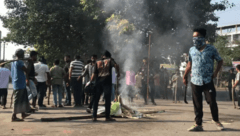
Bangladeshi police forces have forced supporters of deposed Prime Minister Sheikh Hasina to disperse using tear gas and rubber bullets amid massive public demands for her return to the country. This occurred alongside violent clashes between banned student wings of the Awami League and security forces in the Gobalgonj area, where a fire broke out in a police vehicle.
Widespread riots have been witnessed in the capital Dhaka and other regions since Hasina declared her desire to obtain a passport for return from exile in India just one day ago. These first organized protests in support of her after her ouster in August 2024 led to traffic disruption through burning car tires and setting up barricades, as well as fires breaking out in several passenger vehicles.
A 60-year-old bus driver was killed due to smoke inhalation after people set fire to his vehicle in the city of Faridpur on Tuesday, while about 200 protesters temporarily blocked traffic on the long Padma Bridge connecting the capital with the southwestern region. Dozens of improvised bombs also exploded in Dhaka and other parts of the country during recent days, according to local media reports.
Bangladeshi Home Minister Salahuddin Ahmed defended the government's stance, stating that any attempt to escalate security conditions or create instability through foreign conspiracies will not succeed. Meanwhile, a prominent leader of the student wings denied responsibility for the violence incidents, asserting they were carried out by unknown individuals and affirming their belief in peaceful protests.
Hasina faces an absentia death sentence from a special court after being convicted of crimes against humanity, but she denies all charges and describes the trial as biased and politically motivated. The Bangladeshi government rejected her passport application, labeling her a "fugitive criminal," while asserting that it has an active extradition treaty with India to hand her over.
Opposition parties accuse Hasina of imprisoning political rivals, suppressing public opinion, and overseeing widespread human rights violations, which she consistently denies. Meanwhile, Awami League leaders claim hundreds of their supporters were killed in mass riots and hundreds more died under security force custody over the past two years, while Dhaka authorities reject these accusations as targeting the party's supporters systematically.
Analysis & context
Analysis & Context
From an analytical perspective, this scene represents a continuation of acute tensions that have plagued Bangladesh since Sheikh Hasina's regime fell, with political factions clashing over the legitimacy of returning to power and the nature of transitional justice. Observers believe that the passport request reflects a complex political strategy aimed at breaking international isolation, while the central government rejects any return for a war crimes convict sentenced to death in absentia.
In the broader context, UN reports indicate up to 1,400 people were killed during the 2024 protests, most by security forces, creating an environment of instability threatening the country's economic development and democracy. Furthermore, the ban on the Awami League and its prohibition from participating in general elections reflects the depth of political division still existing between the government and opposition.
The Sheikh Hasina case is a focal point in international politics, with India and Bangladesh clashing over her extradition file, while Bangladesh's opposition condemns her previous government for human rights violations. This regional and international competition adds another layer of complexity to the internal scene characterized by violence and ongoing protests.
The government's refusal to grant the passport and its classification of Hasina as a fugitive criminal demonstrates adherence to their understanding of the rule of law, despite international criticism of her absentia trial. In contrast, Awami League leaders claim hundreds of their supporters were killed in mass riots and subjected to security harassment, deepening the lack of trust between both sides.