Sourced fact
The News
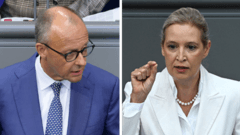
Tensions escalated in the German parliament after Chancellor Friedrich Merz described the Alternative for Germany (AfD) party as a destructive force threatening the country, following the party's landslide victory in the state of Saxony-Anhalt where it secured nearly 44% of the votes. In contrast, opposition leader Alice Weidel attacked Merz's alliance with the center-left, calling it a complete failure and urging his resignation.
In his address to the Bundestag, Chancellor Merz stated that the migration policies proposed by the Weidel party practically equate to "ethnic cleansing" of skilled workers based on skin color and origin, noting that one in six skilled workers in Germany has a migration background. He also highlighted that the party's support for Russia and its deportation policy would negatively affect millions of citizens, paralyzing hospitals, care homes, and restaurants.
On her part, Weidel defended the election results, stating that voters proved Merz's alliance was ineffective, while warning him that his plans would lead to Germany's bankruptcy. She added that mass migration has led to daily violence, knives in streets, attacks on trains and stations, believing her government is pushing the country toward financial bankruptcy.
The German government spokesperson clarified that a planned phone call between US President Donald Trump and Chancellor Merz to commemorate the 9/11 attacks was postponed without setting a new date. He also noted that German domestic intelligence agencies classified the Alternative for Germany in Saxony-Anhalt as a far-right extremist party, while the party promised a deportation campaign for irregular migrants.
In another development, Merz denied the Weidel party's ability to form a government in the state or in Germany due to its lack of an absolute majority, considering the seismic result has changed the German political map since World War II. He also accused the party of election fraud for changing its position on candidate Ulric Schiemond's run for governor hours after the vote.
Sources also reported that Weidel paved the way for cooperation with other parties such as the populist BSW party provided support for Schiemond's candidacy, while one of the party leaders in the state suggested working with the Christian Democratic Union if it abandoned the firewall preventing cooperation with the far right.
Analysis & context
Analysis & Context
Analytically, the AfD party's victory in Saxony-Anhalt represents a fundamental shift in the German political landscape, breaking the long ban that prevented far-right extremist parties from reaching executive power in any of Germany's sixteen states. This win opens a new door for discussion on forming unconventional coalition governments that may include cooperation with populist left-wing parties or even far-right extremist parties provided certain leadership conditions like Ulric Seigmond are accepted.
In a broader context, President Donald Trump's statements praising the AfD party's victory indicate that events in Germany are closely intertwined with international policies and US elections, especially since Trump was scheduled to speak with Merz to commemorate 9/11 before the call was postponed without clarifying the reason. This interweaving reflects how internal issues like migration have become a focus of international alliances and affect major diplomatic relations.
The debate over Germany's "firewall" in politics that prevents traditional parties from cooperating with the far right also stands out, where some officials in Saxony-Anhalt suggested breaking this firewall if certain conditions are met, raising questions about the future of democratic and political stability in Europe.