Sourced fact
The News
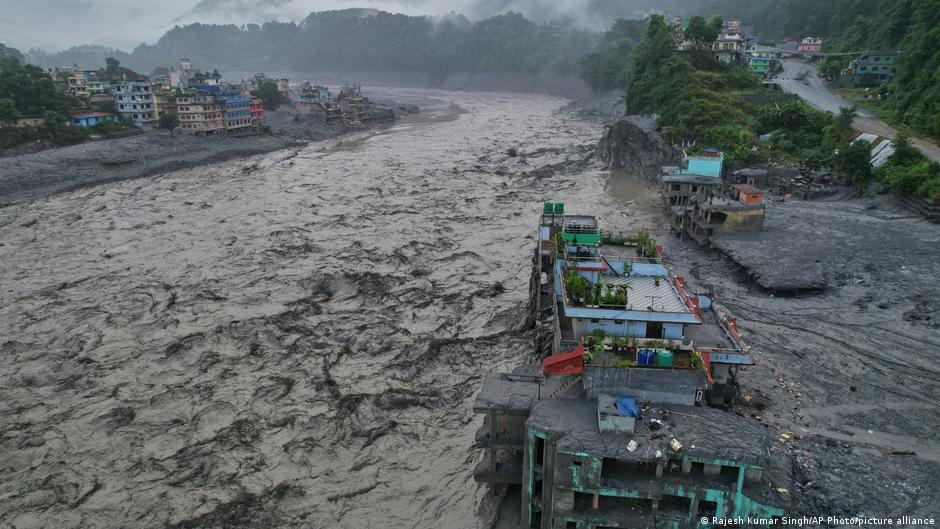
A massive landslide and flash floods caused by it have killed nearly 1,400 people and left more than 5,000 missing in the valleys of Nepal and Tibet. The event was not caused by an earthquake as initially thought, but resulted from a complex series of factors preceded by climate change before the slope collapsed on August 26.
Walter Immerz, a hydrogeologist from Utrecht University in the Netherlands, explained that the failure was not due to a single triggering event, but rather the result of multiple processes working together over years and decades. The collapse occurred at an elevation of about 5,150 meters, where rising temperatures caused glacial retreat and permafrost thawing, increasing slope instability right up until the moment of collapse.
Details of the disaster include the fall of a massive block of rock and ice measuring 110 million cubic meters—a volume equivalent to 44,000 Olympic swimming pools—from the northern face of Langtang Lirung peak. This rare landslide, occurring once every thousand to ten thousand years, traveled at an average speed of 170 kilometers per hour, reaching the border between Nepal and China in just seven minutes.
Researchers from the Global Weather Attribution organization pointed out that rising temperatures due to fossil fuel burning were the primary factor behind this disaster, which exceeded local adaptive capacities. The glacier's edge retreated by 373 meters between 2010 and 2026, while permafrost in the sensitive slope area began to thaw, making the rock walls more fragile.
Professor Friederike Otto from Imperial College London stated that the stability of the "roof of the world" is threatened by collapse, and no local adaptation measures can protect vulnerable populations from such destruction without faster action to transition to zero fossil fuel emissions. Additionally, the earthquake that struck the region in 2015 played a role in weakening the rock mass since then, while heavy rains in October 2025 contributed to increased meltwater feeding the destructive floods.
Analysis & context
Analysis & Context
From an analytical perspective, this event illustrates how anthropogenic climate change driven by fossil fuel combustion has reshaped the Himalayan region over decades. The glacier's edge retreated by 75 meters between 1964 and 2000, then accelerated dramatically with an additional retreat of 373 meters between 2010 and 2026, exposing the supporting rock wall.
In a broader context, data indicates that temperatures in July and August were record highs for the region, with climate change contributing an additional 1.5 degrees Celsius. An unusual blizzard in October 2025 also played a role in generating more meltwater, while the 7.8 magnitude earthquake in 2015 contributed to weakening the rock mass since then.
Researcher Friederike Otto from Imperial College London confirmed that instability caused by warming makes local adaptation insufficient to protect vulnerable populations from such destruction. She added that without faster action to transition to zero fossil fuel emissions, we will inevitably see more disasters of this scale in coming years.
The analysis shows that Nepal's early warning systems were not designed to detect such complex threats exceeding adaptive limits, as floods destroyed several monitoring stations before reaching the border. This confirms that the nature of new climate-related disasters requires entirely new strategies differing from traditional models based on rainfall prediction.