Sourced fact
The News
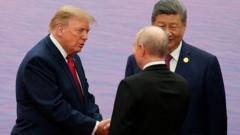
The historic summit that will bring together Chinese President Xi Jinping, Russian President Vladimir Putin, and US President Donald Trump in Shanghai is an exceptional diplomatic event aimed at showcasing China's central role in shaping a new global order. The host city features a futuristic tech showcase including self-driving cars, drones, and robots, reflecting the economic and political character of the summit held under the Asia-Pacific Economic Summit banner.
President Xi is attempting to achieve a delicate balance on the Ukraine file, which has entered its fourth year. China refuses to make the conflict a top agenda item, fearing damage to its relations with Europe and the European Union, which represents a major market for China's export-dependent economy. At the same time, Beijing seeks to maintain its official neutrality, calling for political negotiations without condemning Russia's full-scale invasion, while ensuring it does not turn Russia's problems into China's problems.
President Xi will also face challenges regarding nuclear weapons. Trump wants to include China in any new arms cap agreements after the New START treaty expired last February. The Chinese side refuses to accept the same restrictions imposed on the United States and Russia, arguing that its arsenal is much smaller. This raises questions about its status as a responsible nuclear power and could complicate its position as a global leader.
Xi also fears the meeting could become a stage dominated by Putin and Trump, making his role appear reactive rather than decisive. Despite this, he may leverage the situation to present himself as a stable leader among heads of state surrounded by wars they cannot end. The president hopes to use this summit as a propaganda tool within China to bolster his popularity among party elites ahead of next year's Communist Party Congress, where he expects to be nominated for a fourth historic term.
Xi also deals with serious internal challenges such as the comprehensive real estate crisis that has eroded consumer confidence, rising local government debt, slowing manufacturing, and employment difficulties facing youth. Although there have been no major elections or protests in China for decades, the president pays close attention to satisfying party elites amid these growing problems and public anxiety about the future.
Analysis & context
Analysis & Context
From an analytical perspective, this summit represents a fundamental shift in geopolitical hegemony, with leadership moving from the West to the East. Through this event, China seeks to present itself as an indispensable force in shaping international rules rather than merely reacting to Western pressure.
In the broader context, China faces massive internal economic challenges including a real estate crisis, local debt, and industrial slowdown. Xi is attempting to use external diplomatic success to cover these internal difficulties and boost his popularity among party elites ahead of the upcoming Communist Party Congress.
The nuclear weapons issue remains a strategic point of contention. The United States views China's inclusion in any new treaty as necessary for global security stability. However, Beijing rejects this, arguing that the size of its nuclear arsenal does not justify imposing the same restrictions on countries with larger warhead stockpiles.
Finally, summit dynamics are characterized by uncertainty: Trump and Putin have different agendas and may attempt to dominate the diplomatic atmosphere. This could make Xi appear more as a guest than an architect of the event, although he may benefit from such moments to reinforce his image as a stable global leader amidst chaotic wars.