Sourced fact
The News
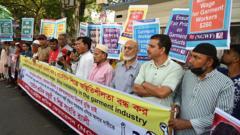
Dozens of factories in Bangladesh's primary garment production region have closed after workers went on strike demanding a raise in the minimum wage, leading to the shutdown of approximately 150 industrial sites this holiday week at textile centers in Savar, Ashulia, and Gazipur. The garment industry is a vital sector for the country, contributing 10% to the Gross Domestic Product (GDP) with annual exports valued at around $4 billion; however, the current strike threatens negative impacts on international buyers if it continues for an extended period.
Workers gathered in Gazipur early Sunday morning along the Dhaka-Tangail road to block traffic, halting movement for an hour before police intervention. Police officer Mohammad Amjad Hussein clarified that officers shut down factories after workers exited their posts, noting that 13 factories were closed Saturday evening and another 16 during the morning unrest. Factory owners cite a legal provision stating "no work, no pay" when production is halted as grounds for suspending operations and withholding wages.
Majumder Hassan Khan, head of the Bangladesh Garment Manufacturers and Exporters Association (BGMEA), called for protection for factories, arguing that participating in minimum wage council negotiations without safeguards for factory security is unjustified. He emphasized that factories unable to produce due to disruptions will remain permanently closed under Bangladeshi labor law. Conversely, Jolly Talukdar, deputy head of the Bangladesh Garment Workers Federation, stated that workers have paid the price for years while factory owners and major traders profit from their exploitation. He considered a request for living wages a basic human demand that no reasonable person could oppose.
The government formed the Minimum Wage Council on November 1st, chaired by a high-ranking district judge, to recommend a new wage structure, expecting recommendations to be completed by the end of November for official implementation starting December 1st.
Analysis & context
Analysis & Context
From an analytical perspective, closing these factories poses a significant challenge to Bangladesh's global economy, as the country is the world's second-largest ready-made garment exporter after China. Experts fear that prolonged unrest could negatively affect international buyers who rely on supply chains in Bangladesh.
In the broader context, Bangladesh's textile sector faces ongoing tension between workers' fair demands and the reality of global competition pushing factories to cut costs. Labor unions confirm that workers have borne costs for years while factory owners and global retailers profit from their exploitation.
Majumder Hassan Khan, head of the BGMEA, stated that the association raises questions about the justification for participating in wage council negotiations without safeguards against arbitrary factory closures. He added that factories unable to continue production due to disruptions will remain closed indefinitely under Bangladeshi labor law.
The government also formed the Minimum Wage Council on November 1st to recommend a new payment structure, with expected amendments becoming effective from December 1st after recommendations are finalized by the end of the current month.