Sourced fact
The News
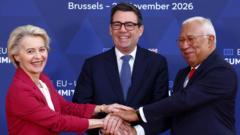
British Prime Minister Rishi Sunak will announce on Monday in Parliament a historic agreement with the European Union that opens promising prospects for improving the economic and social situation over the next decade compared to the last one. This deal, announced on Friday, covers areas including British food exports, emissions trading, and youth exchange programs; the Prime Minister views it as a critical choice between maintaining the struggling status quo or achieving radical change.
A government spokesperson stated that the deal represents the largest growth measure to be presented in this Parliament, expecting it to add around £17 billion to the British economy by removing most checks on food exports against adhering to some European regulations starting in 2028. The agreement also includes a new youth exchange program to be launched by January 2030, allowing over 100,000 young people and scientists from the European Union aged between 18 and 31 to travel, work, and study in the United Kingdom for up to three years, while permitting the same number of British youth to enter Europe.
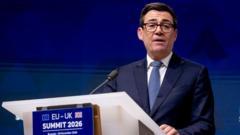
In his scheduled speech, the Prime Minister will confirm that the agreement offers a real opportunity to make the next decade much better for Britain than the one we have just experienced, pointing to the ability to draw an end to a decade of drift and division by hand, which must be seized. He also described the step as a choice between easing pressure on the cost of living or allowing food prices to rise further, and between creating opportunities for youth or depriving them of them, believing that opinion polls show that the British public wants closer ties with the European Union and that this deal achieves that.
On her part, Conservative Party leader Kemi Badenoch will use a speech at the annual meeting of the British Industry Federation on Monday to criticize the European deal, expecting the Prime Minister to focus on higher goals for driving economic growth. She said she sees Europe as always being an important market but not the market of the future, while Reform Party leader Nigel Farage described establishing closer ties with the European Union as a disaster for British companies trying to compete and innovate.
The Prime Minister clarified that both sides are seeking over the coming months to carry out an informal process to consider options available for the long-term relationship between the United Kingdom and the European Union, confirming that the current deal is likely the maximum achievable in this Parliament given what it requires to be implemented. He added that he wants to inform Parliament after its term ends to make decisions on that long-term relationship, having previously suggested potential future options including rejoining the customs union or the single market or a new referendum on full membership, but ruling out any major changes in the relationship before the next general election.
Several former Prime Ministers warned against reopening the debate on rejoining the European Union; Rishi Sunak said the issue is divisive and becomes a major distraction for the government. Baroness Theresa May expressed her surprise that the Prime Minister was thinking about rejoining and called for accepting Brexit and moving forward, while former Sir Tony Blair stated that Britain should only rejoin if the EU carries out reforms and allows more technological innovation.
Analysis & context
Analysis & Context
From an analytical perspective, this announcement represents an attempt by the Labour government to redraw relations with Europe after Brexit, facing significant political challenges given the divergent views on the future of this relationship within British political parties. Bernham notes that polls suggest the British public wants closer relations, but the opposition sees this path as hindering innovation and weakening the competitiveness of local companies.
In a broader context, the decision faces challenges from former political figures such as Rishi Sunak and Baroness Theresa May, who warned against reopening the debate on rejoining the European Union again, considering it distracting and diverting attention from government priorities. Additionally, Sir Tony Blair, who was opposed to Brexit, believes that rejoining should be conditional on EU reforms and allowing more technological innovation.
Bernham's statements indicate that he ruled out major changes in the relationship between the United Kingdom and the European Union before the next general election, committed to Labour Party promises for 2024 not to return to the single market or customs union. This stance reflects an attempt to find a balance between achieving immediate economic gains and maintaining previous political commitments that could be controversial if changed.