Sourced fact
The News
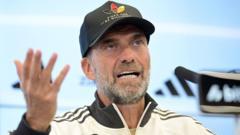
New Germany national team manager Julian Nagelsmann has confirmed that his squad can help ensure the national flag is not co-opted by inappropriate individuals following the Alternative for Germany (AfD) party's win with 43.8% of the vote in the German state of Saxony-Anhalt. This statement was made during a press conference where he announced his first squad, expressing his desire to restore the German flag as a symbol of positive pride rather than a source of doubt or fear for others.
The former Liverpool manager clarified that while the AfD's victory in the Saxony-Anhalt regional elections did not secure an absolute majority in the regional parliament, he anticipated strong results in Sunday's upcoming elections in Berlin and Mecklenburg-Western Pomerania. He noted that although he is not a political expert, the results have led some to question what is happening, while others consider it acceptable; this has driven him, as a sports figure, to wish to rehabilitate the German flag.
Nagelsmann stated he does not want nationalism to be wielded by those who could be misunderstood, preferring the term "positive patriotism" over "national pride," which he fears may be misconstrued. He added that he can be proud to be German while remaining open-minded and retaining compassion and kindness towards everyone, affirming that football is capable of enhancing community spirit and demonstrating the true strength of sport.
He also emphasized the importance of having a sufficient number of doctors and healthcare providers in the country, considering that the role of sports extends beyond the sporting field to include community building. Regarding technical details, Nagelsmann selected 16 non-international players among a squad of 44 for participation in four upcoming Nations League matches over the next two weeks.
The first group, set to play against the Netherlands in Amsterdam and Greece in Augsburg, includes players such as Kai Havertz, Kevin Stöger, and Anton Stach, while Jamal Musiala joined despite suffering two collapses during preparatory matches. A second group including Florian Wirtz and Malick Thiaw will be called up later to face Serbia and Greece, while goalkeeper Manuel Neuer and defender Antonio Rüdiger have retired from international duty following Germany's early exit from the World Cup.
Analysis & context
Analysis & Context
Analytically, the AfD party's victory with 43.8% of the vote in Saxony-Anhalt represents a dangerous historical precedent, as no right-wing extremist party has controlled a German state since the end of World War II, which concluded with the fall of Adolf Hitler and the Nazi regime that carried out the Holocaust. Nagelsmann fears this victory could lead to national pride being transformed into a negative political tool, reflecting deep social and political shifts in contemporary Germany.
In a broader context, Nagelsmann's position highlights the contradiction between sport as a positive community force and political extremism that may distort the state's identity. Sport can enhance a sense of belonging and social synergy, but when extremists intervene in the political arena, they seek to exploit national feelings to achieve their narrow goals. This tension between sport and politics is not new, but it acquires particular urgency with the rise of anti-migration parties across Europe.
Furthermore, Nagelsmann's appointment as a former global manager from Red Bull reflects a shift in the management philosophy of the German national team towards openness to international expertise after the failure of the previous local elite. This transformation comes at a time when Germany needs to strengthen social cohesion and utilize sport as a tool for building a diverse society, moving away from the hardline rhetoric proposed by political opponents.
Finally, Nagelsmann's focus on the importance of having a sufficient number of doctors and healthcare providers in the country links sports issues with broader social concerns, indicating that football can serve as a platform to promote human values and community awareness. This connection between sport and social responsibility represents a new strategic vision for the German national team amidst increasing internal and external political challenges.