Sourced fact
The News
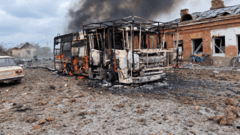
Ukrainian President Volodymyr Zelenskyy announced that Russian air shells struck an aid distribution center in the village of Komishuvakhah in southern Zaporizhzhia, resulting in the death of at least 26 people and injuring five others according to official data. Zelenskyy described the attack as "horrific," confirming that the strikes targeted a site used for humanitarian purposes and hosting displaced persons following a previous attack on a school at the same location.
According to BBC News, regional head Mykhailo Symyk initially confirmed 24 deaths before the number rose to 26 after identifying victims among rescue workers and four police officers. Officials also reported that 27 people were missing after bombs weighing 3,000 kilograms each completely destroyed buildings, while rescue teams continue to operate under pressure from Russian drone attacks that have forced them to halt operations multiple times.
In a speech late Monday evening, Zelenskyy emphasized that Russia was fully aware that local residents in Komishuvakhah were receiving humanitarian aid weekly, considering this attack new evidence of its unwillingness to ease tensions or achieve peace. The Ukrainian president noted these acts come as a counter-reaction to the declaration of a temporary ceasefire that recently helped evacuate civilians from the Russian-occupied city of Oleshky, arguing that intentional killing sends wrong signals inviting further human losses.
Analysis & context
Analysis & Context
From an analytical perspective, this attack represents a continuation of a shift in Russian war strategy moving from traditional military operations to directly targeting civilian infrastructure and humanitarian centers to increase psychological pressure on the population and distract attention from military progress. The repeated targeting of schools, hospitals, and aid centers blatantly contradicts the principles of international humanitarian law and aims to erode the political will of civil society in occupied or conflict-affected regions.
In a broader context, this incident points to Russia's continued control over significant parts of southern Ukraine, including the strategic Zaporizhzhia region located between the main front lines, making it vulnerable to intermittent attacks aimed at isolating residents from international supply lines. Furthermore, the declaration of a regional mourning day reflects the depth of community shock and highlights the difficulty of conducting rescue operations in an active military environment where work teams face drone attacks that prevent continuous operations for extended periods.
Historically, since the start of Russia's full-scale invasion of Ukraine in February 2022, the battlefield has shifted to a war of attrition relying on intensive aerial bombardment of cities and small villages, making rural areas like Komishuvakhah potential targets despite their vital humanitarian role. The lack of official comment from the Russian military adds another layer of ambiguity around the motives for the attack, while Zelenskyy's statements confirm that lessons learned from international negotiations and temporary ceasefires remain insufficient to prevent recurring humanitarian tragedies.