Sourced fact
The News
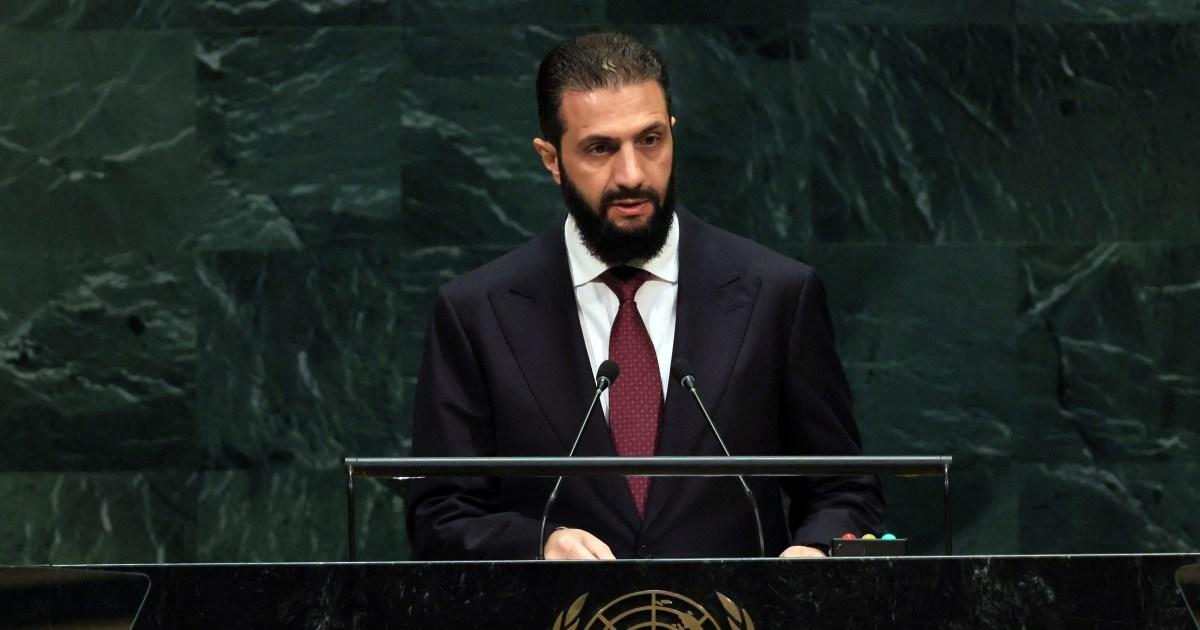
Syrian President Ahmad Shara called upon the State of Israel to immediately withdraw from internationally recognized Syrian territories, emphasizing that continued occupation threatens the stability of the transitional phase and violates international law. This statement was delivered during his address to the United Nations General Assembly, where Shara affirmed that Israeli actions undermine the security and peace achievements Syria attained following its devastating civil war.
In his speech, President Shara stated: "We reject Israel's attempts to impose a new reality and condemn its aggression which undermines peace and security," clarifying that the current situation resembles the old era when Syria feared returning to it. He cited alarming statistics revealing 500 air strikes, over 1,200 ground raids, and 300 Israeli arrests on Syrian territory in recent months.
Regarding the path of national recovery, President Shara described Syria as having moved from a crisis phase to a new opportunity for reconstruction and revival. He pointed to the cessation of bloodshed and destruction, state control over weapons, lifting of international sanctions, and rebuilding of military and civilian institutions. He also added that approximately 3.5 million refugees and displaced persons have returned safely and with dignity after enduring the suffering that had strained regional relations.
This was President Shara's second address to the UN General Assembly since assuming power in 2024 following the ouster of Bashar al-Assad's regime. He called on the international community to endorse the 1974 agreement establishing a United Nations-supervised demilitarized zone between Israeli and Syrian forces, urging Israel to withdraw from the water-rich Golan Heights, which remains Syrian land even with Israel's recent acknowledgment of its status.
Analysis & context
Analysis & Context
From an analytical perspective, President Shara's UN speech represents a fundamental shift in Syria's foreign policy, which had endured prolonged international isolation for years. The new leadership appears determined to break the diplomatic siege and attract political and economic investments by adhering to internationally recognized borders.
In the broader context, rising tensions between Syria and Israel emerge as a key factor affecting the stability of the entire region. These escalations occur amidst Israel's attempts to expand its military and political influence in Syrian border areas, intensifying security concerns among Syrian leadership and the international community.
Moreover, the occupied Syrian Golan issue remains a core point of contention between Damascus and Tel Aviv, as Syria considers this area an integral part of its territory according to international law and treaties. President Shara seeks to use this international platform to reaffirm this legal fact before the global community.
The speech also points to a major transformation in the humanitarian situation in Syria with the return of millions of refugees, reflecting the new leadership's success in managing the reconstruction file and gradually regaining control over Syrian territories.