Sourced fact
The News
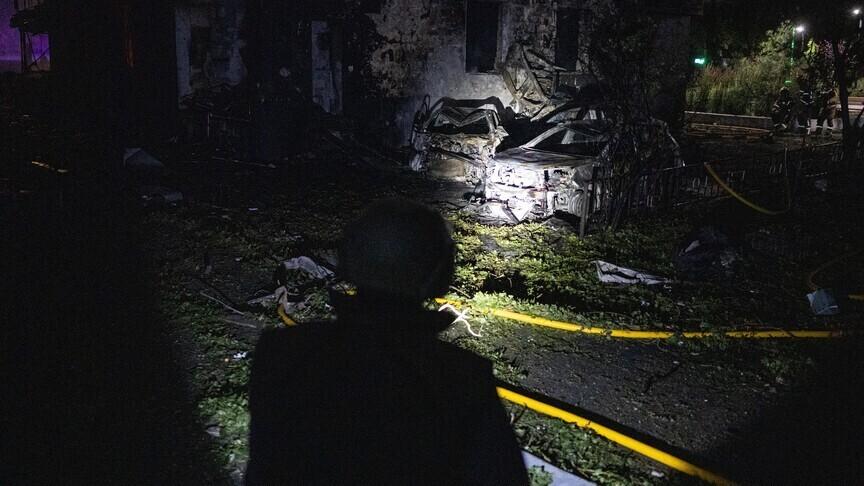
Russia and Ukraine exchanged mutual accusations on Thursday regarding nighttime aerial attacks that resulted in the deaths of eight people in the Ukrainian capital, Kyiv, and the eastern Kharkiv region. Local authorities in Ukraine reported damage to warehouses and residential buildings in the Sviatoshynskyi and Solomianskyi districts due to attacks targeting multiple areas.
The Kyiv Military Administration issued an air raid alert for central Kyiv late Thursday night. Meanwhile, the Ukrainian State Emergency Service (DSNS) reported via Telegram early Thursday that two people were killed and at least eight others injured in the attack. The service added that emergency services are working at full capacity at strike sites and noted that two people were injured in southern Odesa after Russian nighttime strikes ignited a commercial center and a two-story residential building.
In Kharkiv, region head Oleg Sineyukov stated that six people were killed and 12 others injured following a morning attack on a farmstead in the village of Stara Heniletsia. On his part, the Ukrainian Air Force claimed its air defense shot down 220 drones out of 282 launched by the Russian army late Thursday, plus seven missiles.
As for the Russian Ministry of Defense, it claimed to have launched a massive attack on drone production facilities and communication centers supporting the Ukrainian army in Kyiv. It also alleged striking two logistics centers in Odesa storing military supplies and fuel transfer lines to Chornomorsk port. The ministry added that it shot down 40 Ukrainian drones over six regions and Crimea.
In Russia's Krasnodar region, the operations center reported a fire at an unspecified facility in the Dinskoy district caused by debris from fallen drones. It clarified that no injuries resulted from the incident while 50 personnel and 15 pieces of equipment, including units from the Russian Ministry of Emergency Situations, were deployed to extinguish the fire.
Independent verification of these claims is difficult due to the ongoing war, as both states increased their strikes last month targeting logistics centers, ports, and energy infrastructure on the other side, with each party denying intentionally targeting civilian infrastructure.
Analysis & context
Analysis & Context
From an analytical perspective, this scenario illustrates the continuation of mutual military escalation between the two countries in recent months, where the conflict has evolved into a war of attrition targeting logistical, energy, and communication infrastructure on both sides. The exchange of accusations regarding the targeting of civilian or military facilities reflects the difficulty of distinguishing targets amidst widespread destruction, making independent verification of such claims extremely challenging amid continued fierce fighting.
In the broader context, reports indicate that both parties insist their strikes are directed at military objectives or facilities linked to military activities, despite growing evidence of damage to critical installations such as hospitals and residential buildings. This contradiction between official narratives and on-the-ground reality contributes to deepening international polarization and complicates ceasefire efforts or measures to limit civilian destruction with each passing night.
Furthermore, the increased reliance on drones in nighttime attacks is changing the nature of the battle, as these technologies enable precise, low-cost strikes against distant targets, thereby increasing the danger posed to both civilians and military personnel in urban and rural areas alike.