Sourced fact
The News
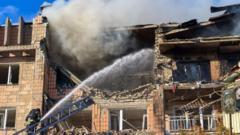
Ukrainian President Volodymyr Zelensky announced that Russia had struck six Ukrainian energy sites shortly after US President Donald Trump declared a ceasefire in the energy sector. Zelensky reported that the Russian strikes hit gas stations and energy infrastructure across Ukraine, resulting in 33 injuries. According to Ukrainian news agency Ukrinform, the Russian attack led to power outages in the city of Izyum. Zelensky noted that the Russian attacks were a response to Trump's announcement, stating: "I believe it was Putin's reply to President Trump."
Earlier, Trump announced a deal to import Russian diesel to the US, sparking concerns about the implications of this decision on the Ukrainian conflict. Russia, however, expressed discomfort with the idea of a ceasefire, with Russian Foreign Minister Sergey Lavrov stating that Ukraine does not deserve a ceasefire. In contrast, the UK, France, Canada, and the European Union expressed support for the ceasefire, with some European countries having reservations about Russia's commitment to the agreement.
The Russian attacks on Ukrainian energy infrastructure have led to power outages in various parts of the country, leading to power rationing in some areas to prevent overloading of damaged equipment. The government energy agency Ukrenergo reported new power outages in the regions of Kharkiv, Donetsk, and Zaporizhzhia due to damage to energy infrastructure.
Meanwhile, the city of Kyiv witnessed a drone attack targeting a high-rise residential building in the Darnytskyi district. Kyiv Mayor Vitali Klitschko reported on Telegram that the drone attack hit a high-rise building, causing fires in the building's parking lot. However, the number of casualties has yet to be determined.
Since the beginning of the conflict, Russia and Ukraine have repeatedly targeted each other's energy infrastructure, leading to power outages and negative economic impacts. According to BBC Verify analysis, attacks on energy infrastructure in both Ukraine and Russia have increased in recent months, with a notable rise in Russian attacks on Ukrainian infrastructure. Despite Trump's call to stop attacks on energy infrastructure, the situation remains tense, with Ukraine viewing this decision as giving Russia an opportunity to enhance its military capabilities.
Analysis & context
Analysis & Context
Analytically, the ongoing Russo-Ukrainian conflict continues to impact global fuel prices. US President Trump seeks to strengthen relations with Russia by allowing the import of Russian diesel to the US, raising concerns about the impact on the Ukrainian position.
In a broader context, Russia and Ukraine continue to carry out attacks on energy infrastructure, increasing tensions. According to BBC Verify analysis, attacks on energy infrastructure in both countries have significantly increased before winter.
European perspectives also need consideration, with reactions ranging from support to skepticism. For instance, European Union High Representative Josep Borrell welcomed the ceasefire when it proves effective, while Estonia expressed doubt about the current ceasefire's effectiveness.