Sourced fact
The News
The National Transportation Safety Board (NTSB) reported that critical components of a crashed Learjet 60 in Florida were found between 1.3 and 3.8 miles from the impact site, according to an investigator speaking on Tuesday. This discovery includes a part that controlled the nose's up-and-down movement, leading investigators to believe these parts separated from the aircraft before the incident that killed all nine people on board.
Tom Chapman, a member of the NTSB Board, said the agency found "most" of the left elevator in the aircraft—a tail control surface—broken into three pieces. Chapman explained that the separation distance of these parts from the crash site led investigators to conclude they fell before impact, emphasizing that knowing about their loss is crucial evidence for directing investigations toward other aspects.
In flight recorder audio recordings, one crew member can be heard reporting "moderate air turbulence" and stating the crew was dealing with ice before saying the plane was "collecting rain" and needed to climb. The situation suddenly changed when the same voice reported the plane was descending at 10,000 feet per minute, followed by the captain's screams that they were in an excessive speed condition and descending at 20,000 feet per minute before declaring they would hit the ground.
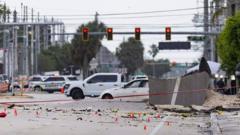
The aircraft was en route from Austin, Texas, to the Bahamas when it pitched down and struck a multi-lane highway strip in Palm Beach, exploding upon impact. Authorities are also facing challenges accessing the wreckage due to the massive crater left on the road, while investigators now work to determine whether the loss of the left elevator was the primary cause of the collapse or if immense forces on the aircraft caused its separation.
Analysis & context
Analysis & Context
Analytically, the discovery of plane parts far from the impact site provides strong evidence that the disaster was not merely a sudden collision resulting from a simple human error, but may have stemmed from severe mechanical failure or exceptional weather conditions leading to structural disintegration before impact. These details underscore the importance of analyzing weather data and audio recordings to understand the sequence of events with precision.
In a broader context, accidents involving fixed-wing private aircraft like the Learjet model are highly sensitive to sudden weather changes, especially in the presence of ice or severe turbulence that can affect aircraft stability and controllability. Such incidents are often complex to investigate due to the rapid destruction caused by direct downward impact, making physical evidence collection extremely difficult.
This incident also highlights the challenges aviation authorities face when investigating private aircraft accidents compared to large commercial jets, where flight data recorder (black box) and sensor data may be less comprehensive or not available with equal efficiency. It underscores the vital role of the National Transportation Safety Board (NTSB) as an independent body ensuring transparency and drawing lessons to prevent such tragic disasters from recurring in the future.