Sourced fact
The News
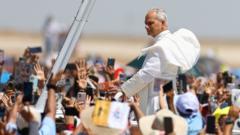
Pope Leo XIV, known as the "Peruvian Pope," celebrated Mass in the city of Chiclayo in northern Peru, where he served as a shepherd bishop before his election in May 2025. The ceremony took place on Friday at a park in the Pimentel district, approximately 10 kilometers from the city center, marking the first stop of his tour through Latin America. The Vatican estimates that more than 1.5 million people gathered to welcome the Pope at this emotional event, drawing crowds from Peru and neighboring countries.
During his address, the Pope thanked the attendees for their love and prayers, especially those offered during a difficult period in his health following surgery to treat lung cancer just weeks prior. He noted that through God's grace he overcame this trial, while describing the large crowds who waited in intense heat as a manifestation of the spirit of unity he sought during his episcopal service between 2015 and 2023.
Teacher Lisbet Diaz stated that the Pope had returned to his home and that Chiclayo celebrates him, noting that he lived in the country for so long that he became a citizen in 2015. She added that many still remember moments such as assisting in setting up charitable kitchens during the COVID-19 pandemic or riding horses through deep floodwaters to help victims. They also recounted stories of his love for Peruvian cuisine and playing tennis at the "El Trebol" restaurant adjacent to the cathedral.
Although the city usually has a population of 800,000, the number of attendees doubled to over 1.5 million, prompting hotels to sharply raise room rates. Father Samuel David Miranda Aachi said that the Pope worked to bring Peruvians closer to the Church and strengthen unity among people. Teacher Diaz also pointed to the Pope's role in helping Venezuelan migrants who were suffering from political and economic crises in their home country.
The ceremony ended with honoring the Pope, who expressed his gratitude to the attendees, saying that looking at their faces stirred a prayer of thanksgiving in his heart for the blessing they had given him. People gathered in the cathedral square, which houses a small museum dedicated to commemorating his previous periods of service, where photos documenting his deep humanitarian and spiritual contributions to the region were displayed.
Analysis & context
Analysis & Context
From an analytical perspective, Pope Leo XIV's return to Chiclayo represents a profound symbolic moment reflecting a shift in the concept of spiritual leadership from merely an administrative position to a community figure deeply rooted in the land he lived and worked in. The emotional interaction between the massive crowd and the Pope highlights how ethical leadership can create bonds that transcend geographical and political borders, especially in Latin America, a region facing significant social and economic challenges.
In a broader context, the Pope's visit to Peru as the longest stop on his first tour of Latin America underscores the country's importance to the global Catholic Church. The Pope's history with Peru, starting from living there from 1985 until 2023, and his establishment of social institutions such as soup kitchens during the COVID-19 pandemic, reflects a model of spiritual leadership focused on direct service to those in need.
Additionally, addressing the issue of Venezuelan migrants demonstrates how religious leaders can play a mediating role between governments and local communities during humanitarian crises. The praise bestowed by Pope Francis upon Pope Leo for his prudent handling of the "Sodalitium Christianae Vitae" life matter highlights the importance of transparency and ethical responsibility in managing major religious institutions.
Finally, transforming the city into a global celebration center during the visit reflects the power of religious symbolism in uniting local and international communities, where public facilities were converted into places of celebration and remembrance, highlighting the social role of the Catholic Church in building national and cultural identity in Peru.