Sourced fact
The News
NATO Secretary-General Mark Rutte announced that the alliance will defend against any threats in outer space following reports indicating Russia's readiness to launch a satellite carrying a nuclear warhead. Intelligence information has been exchanged among alliance countries regarding the possibility of this launch within the next 60 days, according to unnamed German media sources citing the original origin of the reports.
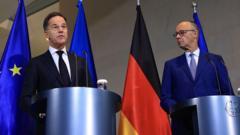
At a press conference in Berlin, Rutte confirmed that the alliance will work to secure every inch of its territory, including airspace and outer space. He also indicated that the alliance has multiple options for response in the military domain, assessing deterrence and defense, and updating them as necessary. German Chancellor Friedrich Merz did not confirm or deny Russia's reports but stated they reveal the level of escalation Moscow is heading towards.
Meanwhile, Kremlin spokesman Dmitry Peskov denied seeing these recent reports and considered relying on anonymous sources unworthy of seriousness. The Russian embassy in Berlin rejected what it described as false claims, stating that the reports are part of a propaganda campaign, while a German official warned against excessive alarm over hypothetical dangers without confirming the facts.
Josef Asbächer, head of the European Space Agency, described the presence of nuclear weapons in space as the ultimate nightmare scenario. Reports indicate that the Russian satellite named "Sputnik-S" is equipped with a nuclear warhead capable of disabling or destroying other satellites critical for communications and surveillance.
Sources recall that Russia is a party to the 1967 Outer Space Treaty, which prohibits weapons of mass destruction in orbit, while countries like the United States and China have developed capabilities outside the treaty scope to target enemy satellites. In 2024, the United States claimed that Russia was developing an anti-satellite weapon carrying a nuclear warhead, which President Vladimir Putin denied, stating his position is clear and completely opposed to deploying nuclear weapons in space.
Analysis & context
Analysis & Context
From an analytical perspective, NATO's decision to respond to space threats represents a major strategic shift reflecting growing concerns about the militarization of outer space. This stance comes amid escalating geopolitical tensions between Russia and the West, where major powers are seeking to secure their security interests in both traditional and non-traditional domains such as space.
In the broader context, outer space remains an extremely sensitive area due to its vital importance for communications, navigation, and military intelligence. Although the 1967 Outer Space Treaty prohibits placing weapons of mass destruction in orbit, other countries are exploring capabilities outside the treaty's scope, such as targeting enemy satellites.
The presence of nuclear weapons in space is considered the ultimate nightmare scenario by European Space Agency head Josef Asbächer, highlighting the catastrophic risks humanity could face if this domain turns into a battlefield. These developments underscore the urgent need for a new international dialogue to reshape security rules in outer space.
Finally, the divergent reactions from Moscow, Berlin, and Washington highlight the deep divide in security perceptions among major powers, making the future of outer space a central issue in any upcoming international negotiations.