Sourced fact
The News
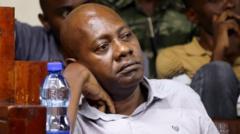
A Kenyan court announced today the conviction of Christian cult leader Paul Mackenzie, who preaches the Day of Destruction, on charges of the non-deliberate killing of 123 of his adult followers. Mackenzie was found guilty before the Mombasa court for instructing his followers to fast to death in the coastal Shakahola forest between January 2021 and September 2023, according to Reuters.
In a prior legal precedent, Mackenzie was sentenced last month to 200 years in prison on charges of killing 191 people, mostly children, in the same mass incident. Although Mackenzie denied the charge of non-deliberate killing, his lawyer announced their intention to appeal after the final verdict, as reported by Reuters regarding the progress of legal proceedings.
Additionally, 29 other individuals, including Mackenzie's wife Rhoda Momba Mau, were convicted for their roles in the non-deliberate killing of 123 people, while 60 other defendants were released despite Kenya's Attorney General indicating their intention to appeal against their convictions. Mackenzie, who describes himself as a priest, was arrested in 2023 after more than 400 bodies were discovered in shallow graves, according to a statement from the Attorney General's Office issued on Friday.
The court confirmed that Mackenzie "systematically convinced his followers to fast to death," as reported by Kenya's Attorney General in a statement about today's verdict described as "final" in the Shakahola cases against him. The prosecution explained that Mackenzie and his associates operated under a suicide contract of fasting to die "to satisfy Jesus," arranging for children to die first, then women, then men, with the intention that Mackenzie would be the last to die.
Analysis & context
Analysis & Context
From an analytical perspective, the Shakahola case highlights the severe gap in official oversight of extreme religious activities that may persist for years without effective institutional intervention. The gravity of the case prompted Kenyan President William Ruto to establish a special investigative committee, although this committee was later declared unconstitutional, raising questions about judicial independence and the state's responsiveness to security challenges arising from religious groups.
In a broader context, Mackenzie's case emerges as a case study of the phenomenon of "deadly rituals" that use fasting and worship as tools for controlling the body and mind. This phenomenon is not new globally but takes on a horrific character when it transforms into organized mass killings. Mackenzie's teachings, which he described as making education, medicine, and gemstones sinful, contributed to isolating followers from society and facilitating their elimination.
Oral testimonies during the trial indicate that Mackenzie practiced physical violence against opponents of his teachings, where some were killed by beating until death, reflecting the nature of the cult as a repressive entity that does not respect human life but exposes it to sacrifice in the name of religion. Despite defendants' claims that victims fasted of their own free will, evidence points to systematic psychological and physical pressure leading them to death.
This case serves as an international warning about the importance of establishing strict legal frameworks to monitor religious groups that may slip into extremism or exploitation, especially when they adopt doctrines rejecting medical science and basic education. The revelation of hundreds of bodies has contributed to changing public awareness regarding the dangers of joining cults that are not subject to any recognized civil or religious oversight.