Sourced fact
The News
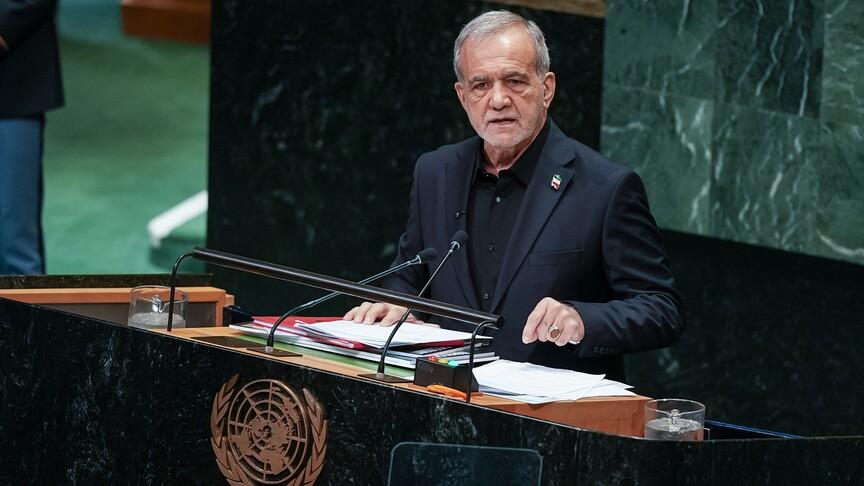
Iranian President Masoud Pezeshkian confirmed in an interview with CBS News on Friday that Tehran remains open to resolving the dispute with Washington, provided trust is first rebuilt. This statement came as he arrived in New York to attend the 81st session of the UN General Assembly. He stated that Iran has asked the United States to prove its intention not to overthrow its government or administration, considering that continuing sanctions and threats threaten American credibility.
In his remarks, Pezeshkian questioned whether the United States is serious about resolving issues with Iran, expressing confusion over its bombing of Iranian cities amidst negotiations and the signing of a memorandum of understanding in mid-June. He noted that Israel speaks of an American intention to weaken the Iranian government rather than negotiate, arguing that American actions do not align with what was officially written in agreements.
The Iranian President linked distrust to the United States' continued execution of strikes and bombings of scientific and administrative sites in Iran. He asked Americans to consider Tehran's perspective, stating that overthrowing the Supreme Leader and failing to honor agreements makes resolution extremely complex, something that cannot be reduced to simple words.
Pezeshkian called for an end to US support for Israel, which he described as committing acts considered genocide by Iran, urging Washington to act based on justice and fairness rather than displacing civilians or targeting hospitals and researchers. He recalled that the war launched by the United States and Israel against Iran on February 28 left thousands dead before Tehran retaliated with attacks on Israeli and American sites in countries across the region.
He stated that negotiations have stalled due to disagreements over navigation in the Strait of Hormuz, a vital strategic route for global energy and goods supplies. Pezeshkian emphasized that the continuation of daily sanctions remains an obstacle to any real progress toward peace in the region.
Analysis & context
Analysis & Context
From an analytical perspective, President Pezeshkian's stance reflects Iranian resilience amidst ongoing security and economic tensions in the region since last February, when the United States and Israel launched a war against Iran that resulted in thousands of deaths. Tehran responded with attacks on Israeli and American sites in countries across the region, deepening the mutual distrust between both sides.
In a broader context, the Iranian President's statements suggest that the core of the dispute is not merely traditional political differences but relates to the United States' inclination to undermine Iran's infrastructure and disrupt its internal stability. Furthermore, the continuation of American sanctions serves as a primary pressure tool used by Washington to drain Iran's economic resources and prevent it from developing its nuclear programs and ballistic missiles.
Regarding the Strait of Hormuz crisis, it represents a fundamental point of disagreement that has hindered reaching a final agreement between Tehran and Washington since mid-June last year. This strait is considered one of the most important strategic shipping routes in the world for transporting energy and goods, making any tension within it a direct threat to global economic security.
Finally, the Iranian President's calls to end US support for Israel and apply justice instead of displacing people or killing innocents reflect a shift in Iranian rhetoric toward linking the nuclear file with the humanitarian file in the Middle East.