Sourced fact
The News
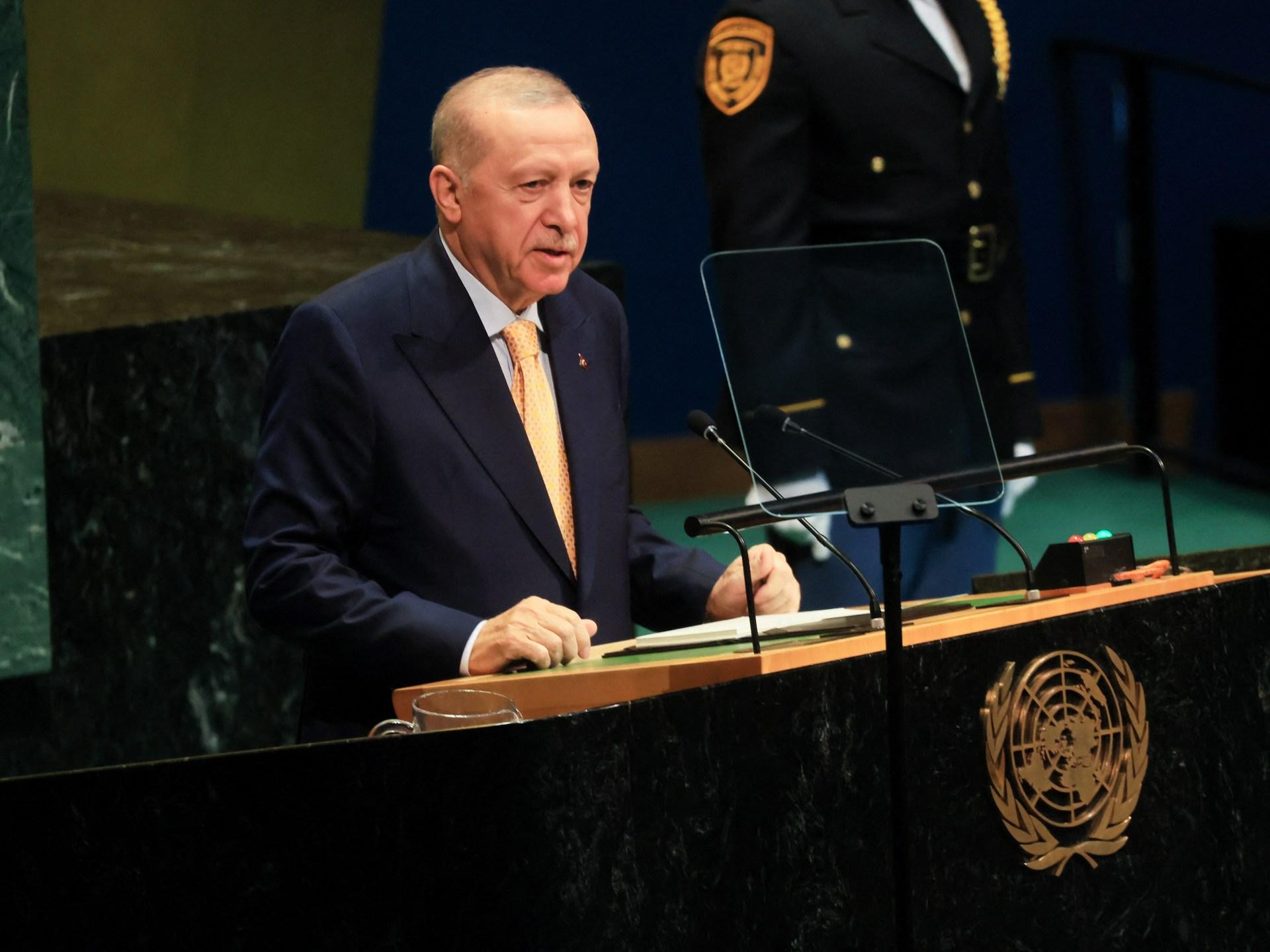
Turkish President Recep Tayyip Erdogan strongly condemned Israeli actions in Gaza and the occupied West Bank during a speech delivered to the United Nations General Assembly, describing the humanitarian situation as catastrophic and issuing stinging criticism of Israeli authorities. In a notable development, the Israeli delegation exited the meeting hall, while Palestinian delegations applauded and endorsed President Erdogan's remarks.
President Erdogan clarified that the ceasefire achieved with US leadership under Donald Trump contributed to halting hostilities, but he highlighted that war crimes continued despite this agreement, pointing to the deaths of over 1,300 civilians in Gaza. He also noted that Hamas and other Palestinian factions accepted the second phase of the ceasefire deal, yet Israel did not cease its operations, while the West Bank faces its most difficult times due to the illegal settlers' occupation of the region.
Erdogan described the Gaza Strip as "the largest forced concentration camp in our time" and reiterated that he is facing a genocidal mindset that cannot be satisfied with killing, asserting that anyone with a conscience or compassion cannot ignore this tragedy. He also attacked the UN General Assembly, stating it has failed in its duty to maintain peace and stability since its founding 81 years ago, considering it has entered a phase of disorder and deterioration in Palestine, Lebanon, and Sudan.
On the political front, President Erdogan addressed Palestinian President Mahmoud Abbas's absence from the meeting due to the US refusal to issue him an entry visa for the second time in two years, affirming that Turkey will remain the voice of a free and sovereign Palestinian state even without his personal presence. He also touched upon the Russia-Ukraine war, expressing his sincere hope for ending the conflict while preserving Ukraine's sovereignty and territorial integrity.
Analysis & context
Analysis & Context
From an analytical perspective, President Erdogan's speech at the UN represents a significant diplomatic escalation reflecting a shift in Turkish rhetoric toward the Israeli-Palestinian conflict, moving beyond mere political support to explicit condemnation of international crimes. This stance comes amid increasing tensions between Ankara and Washington, particularly with Trump's support for Israeli actions and ignoring the ceasefire agreed upon by Turkey and other nations.
In a broader context, Erdogan's description of Gaza as a "concentration camp" implies recognition of the immense human suffering faced by civilian populations, aligning with many international human rights reports that are often marginalized in prevailing Western political discourse. Additionally, Erdogan's criticism of the UN reflects growing sentiment among some developing countries regarding the organization's ineffectiveness in protecting civilians in major conflict zones such as Gaza, Yemen, and Sudan.
The speech also highlights major diplomatic contradictions, where world leaders attend while the Palestinian President is barred from entering the hall, reinforcing the narrative of marginalizing the Palestinian cause before the international community. This marginalization pushes countries like Turkey to adopt a more aggressive role in defending Palestinian rights, leveraging current popular and regional support for the issue.
Finally, Erdogan links multiple issues such as the Ukraine war and the Palestinian conflict, indicating an attempt to set a new global agenda focused on ending major wars while preserving the sovereignty of weak states, a move that may face significant challenges from powerful forces controlling the UN Security Council.