Sourced fact
The News
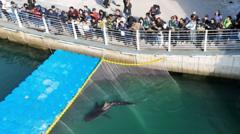
The famous dark shark "Bukangi" has become a focal point of controversy in Busan, South Korea, as it has returned to the canal from which authorities had removed it last week. On October 8th, rescue efforts took eight hours to extract the three-meter-long shark from the canal, but it reappeared the following day, bypassing the barriers that had been installed.
A government official stated to the BBC that barriers had been reinforced to prevent the shark's return, but it still circles around the canal's opening. The official said, "We decided to end the rescue operations after assessing the shark's health condition."
Experts believe the shark may have been drawn to the canal due to the warm waters and abundant fish in the area. The shark's presence has attracted over 1.6 million visitors to Busan, boosting tourism in the city.
However, experts are concerned about the shark's health, noting apparent injuries and a refusal to eat. A social media user wrote, "I hope the shark can safely return to its natural habitat."
The issue divides opinion between supporters who believe the shark should remain in the canal as a symbol of tourism in Busan, and opponents who argue it should be returned to the sea. With the shark continuing to return to the canal, it seems resolving the problem may take longer.
Analysis & context
Analysis & Context
Analytically, Bukangi has become an unexpected symbol of tourism in Busan, drawing over 1.6 million visitors in just one month. This highlights how unexpected natural phenomena can positively impact local economies. However, there is concern regarding the shark's health, with apparent injuries and a lack of appetite.
In a broader context, Bukangi's appearance reflects climate change-induced increases in sea water temperatures, which may lead to more marine animals appearing in coastal areas. This could present environmental and health challenges for marine life and local communities.
It is worth noting that ongoing rescue efforts for Bukangi highlight the challenges faced by authorities in dealing with unexpected natural phenomena, which can have multifaceted economic and environmental impacts.