Sourced fact
The News
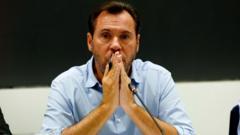
Spanish Transport Minister Óscar Puente has declared his refusal to resign from his post despite mounting pressure following the tragic high-speed train collision that claimed at least 69 lives. Speaking at a press conference in Madrid's capital, he affirmed that he "conceals nothing" and emphasized that his current mission is to resolve the issue rather than engage in debate regarding his continued tenure.
The accident occurred early Wednesday morning near the town of Onda in Toledo province, central Spain, when a high-speed train operated by Renfe collided with a stationary train belonging to Iryo traveling at speeds ranging between 160 and 200 kilometers per hour. This impact caused the front carriages of the moving train to merge with the rear of the stationary train, resulting in a disaster considered one of the worst rail tragedies in modern European history.
In an effort to clarify the sequence of events, Puente stated that a critical computer malfunction occurred around 8:30 AM, temporarily halting six moving trains before erroneous orders were issued to restart them without speed restrictions, despite a fault in the front train located 25 kilometers away—a situation he described as "unthinkable."
Audio recordings leaked to Spanish media revealed conversations between train drivers and the control center just minutes before the collision. The recordings suggest that one train was allowed to move while the other remained stopped on the track, sparking condemnation from certain politicians who labeled these recordings "fraudulent" via platform X.
Prime Minister Pedro Sánchez noted that public trust in Spain's high-speed rail network has crumbled following two similar incidents within a single year. He pointed out that last January's accident on the same route between Madrid and Seville resulted in 46 deaths in Adámez.
On her part, Irene Montero, a Podemos leftist party candidate for Prime Minister, stated that responsibility for the incident should not be placed on a single individual. She emphasized that train drivers and experts had been warning for years about releasing the rail sector without success.
While the conservative People's Party joined calls from the CSIF union for Puente's resignation, the minister declared he would not retreat from his position, stating he cannot use any factor as a shield behind him. He clarified that the investigation will reject any human error if proven and will take necessary actions based on the findings.
The country is currently observing three days of mourning while victims' families and survivors struggle to understand how the disaster occurred. Many families remain in uncertainty regarding their loved ones, such as 54-year-old Rubén San Emeterio, whose family still awaits information about his whereabouts.
Analysis & context
Analysis & Context
From an analytical perspective, the transport minister's refusal to resign presents a significant challenge amidst general expectations that major disasters often lead to government resignations or rapid ministerial changes. However, the current stance reflects an attempt to maintain governmental stability and complete technical investigations before issuing any premature judgments, especially given reports suggesting potential human errors or technical issues in control systems.
In a broader context, this incident was not the first of its kind on Spain's railway network. Another accident between Madrid and Seville in January last year also claimed 46 lives, severely damaging public trust in the high-speed rail system. Prime Minister Pedro Sánchez had previously expressed his dismay at the recurrence of such disasters within a single year, describing the situation as "unacceptable."
Calls for resignation come at a time when Spain is experiencing profound human tragedy, with victims' families still awaiting information about missing loved ones while the nation observes three days of mourning. The list of casualties included a 24-year-old athlete and a former government minister, intensifying public emotions and pressure on officials to handle the situation with sensitivity.
Finally, preliminary analyses suggest the incident may have resulted from a complex interaction between a computer failure that halted trains before restarting them without sufficient restrictions, alongside challenges in releasing the rail sector that experts and drivers have warned about for years.