Sourced fact
The News
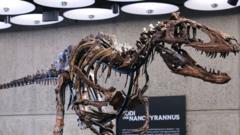
Sotherby's in New York auctioned off the skull of a Nanotyrannus dinosaur, known as Judy, for $47.3 million, making it the second most expensive dinosaur fossil in the world. Judy was discovered in the Hell Creek Formation in Montana, the most studied geological site in the world. Initially evaluated as a young T. Rex, it was identified as a new species in October 2023. The fossil includes a well-preserved skull and approximately 191 bone elements. This dinosaur is one of only three of its kind known to science.
These sales have sparked debate among scientists about whether dinosaur remains should be sold privately or displayed publicly. Professor Steve Brusatte, a paleontologist at the University of Edinburgh, said these sales are "troubling" as they might lead to the disappearance of dinosaurs from public view. He added that such sales could negatively impact scientific research and general education.
On the other hand, Megan Jenkins, a paleontologist at the University of Portsmouth, noted that there are two sides to the discussion. She pointed out that a lot of time, effort, and money goes into extracting these samples. Jenkins stated that she "does not regret people's desire to sell them for large sums," noting that these samples usually end up in museums eventually.
It is worth noting that this sale follows the sale of a T. Rex, known as Goss, for $50.1 million last July, making it the most expensive to date. This sale is indicative of the growing interest among the wealthy in dinosaur fossils.
Analysis & context
Analysis & Context
Analytical Perspective
The debate over selling private dinosaur structures instead of displaying them in museums reflects the tension between the scientific and commercial value of fossils. Many scientists argue that dinosaur structures should be available for scientific research and public education, while others believe that private sales can provide the necessary funding for the extraction of more fossils.
Historical Context
The "Dueling Dinosaurs" structure was discovered in 2006, which was crucial in confirming that Nanotyrannus and T. Rex are separate species. This discovery has changed scientists' understanding of dinosaurs during the Cretaceous period.
Impact on Scientific Research
Selling dinosaur structures for huge sums can limit the ability of scientific institutes to obtain these structures for research and education. This could hinder the ability to better understand Earth's history and ancient life.