Sourced fact
The News
Local authorities in Yemen announced that more than 900 families have been displaced over just two days due to the intensification of clashes between government forces and the Houthi movement in western Taiz Governorate. Preliminary figures indicate that 917 families fled their homes on Thursday and Friday.
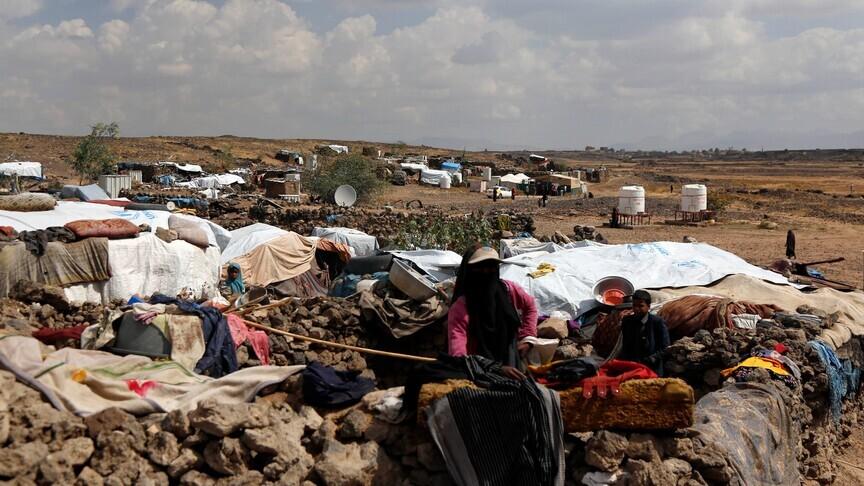
The International Planning and Cooperation Office of the Yemeni Government stated that the displacement has spread across several communities and refugee camps following attacks on residential areas and sites hosting displaced persons, particularly in the Maqbina and Al-Jabal Al-Hashi regions.
The office noted that families were forced to flee neighborhoods such as Azal Al-Yemen, Al-Abdala, and Al-Shamaliya, along with Al-Jub camp and Al-Rahba and Ar-Reji camps, moving to safer areas in Al-Jabal Al-Hashi and the Ma'afar region.
Authorities warned that the number of displaced persons could rise further if fighting continues, noting that many families fled without warning, leaving behind their possessions and essential supplies.
The office has called on local and international relief organizations to intervene urgently to provide shelter, food, water, and sanitation before the humanitarian crisis worsens, which they described as "extremely exhausting."
This displacement comes amid severe clashes that began on Thursday in several fronts across Taiz regions and neighboring governorates such as Hodeidah, near the strategic Bab el-Mandeb Strait.
Local media reports citing military sources indicated that dozens of soldiers from both sides have been killed and wounded since fighting intensified, while civilians were also killed and injured in airstrikes, though no unified official casualty figure has been released yet.
This violence forms part of a series of artillery exchanges that began in July, following the end of a relative period of calm on Yemeni fronts after the UN-brokered ceasefire in April 2022.
Analysis & context
Analysis & Context
From an analytical perspective, this new escalation in Taiz represents a major setback to the ceasefire efforts achieved through international mediation in April 2022, as front lines have resumed activity after a period of relative calm. Taiz is considered one of the most damaged governorates in Yemen since 2014 and is a strategic region located between government-controlled areas and Houthi-held territories, making it a primary arena for periodic skirmishes.
In the broader context, local media reports indicate that dozens of soldiers from both the government forces and Houthis have been killed and wounded since fighting intensified, while civilians have also fallen victim to airstrikes on residential areas. This deteriorating humanitarian situation is one of the most significant challenges Yemen currently faces, with acute shortages of shelter and essential services worsening alongside mass civilian displacement.
The strategic location of Bab el-Mandeb Strait near the region adds additional pressure to Yemen's military and political landscape, increasing the importance of controlling surrounding areas within the complex geopolitical equation. Furthermore, the continuation of these clashes hinders reconstruction and stability efforts that had previously garnered high hopes before the new wave of violence erupted in July last year.