Sourced fact
Today's top technology stories
Today's technology news covers intertwined issues spanning politics, economics, and science. U.S. President Donald Trump announced plans to impose restrictions on building data centers abroad, while Anthropic shares suffered a sharp decline in the stock market following its initial public offering (IPO). In a parallel development, an employee at the same company claims to have proven the famous Riemann Hypothesis using Anthropic's artificial intelligence, sparking debate over technology's role in solving complex scientific problems.
Trump threatens to ban US companies from building overseas data centers
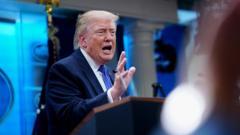
U.S. President Donald Trump announced during a press conference following his visit to Asia that he intends to ban American companies from building data centers outside the United States, threatening heavy fines for violators. This move aims to curb China's dominance in artificial intelligence infrastructure, with Trump emphasizing the need to contain such projects domestically despite approximately 3,000 existing or under-construction centers according to the Pew Research Center. He noted that many of these facilities are located in rural areas and raise concerns about pollution and energy consumption. Canada is being considered as an alternative to Finland, where some construction work has paused due to environmental concerns, though details on implementing this new ban remain unclear at present.
Anthropic Shares Drop After IPO Amid Global Tech Market Decline
Anthropic's artificial intelligence shares fell by more than 12% to approximately $85 on Friday, marking a return near its starting point after its IPO, which raised over $8.1 billion for the company. This decline occurred amid a broad sell-off affecting major global technology indices such as the S&P 500 and the Dow Jones Industrial Average, with shares of other major companies including NVIDIA, Tesla, and Meta also dropping. Strategist Ed Moy noted that investors are re-evaluating price versus growth, reflecting Wall Street's shift from rewarding growth at any cost to demanding stronger cash flows and a clear path to profitability.
Anthropic Mathematician Claims AI Proves Riemann Hypothesis
Levent Alpöge, a mathematician and employee at Anthropic, claims to have proven the famous Riemann Hypothesis using the company's artificial intelligence. This announcement came one day after the company's stock market debut, where Alpöge stated he spent about six weeks preparing the detailed proof for this longstanding mathematical problem. If verified, it would be considered one of the most significant scientific achievements in history; Alpöge described it as "a new dawn for science with something much bigger." He worked on a non-public version of Anthropic's conversational robot Claude to generate the proof, which exceeds 250,000 pages in Lean programming language. The hypothesis, named after mathematician Bernhard Riemann, concerns the distribution of prime numbers and has been an enduring mathematical puzzle for nearly 170 years due to its complexity. Alpöge confirmed he spoke with Anthropic CEO Dario Amodei on Sunday regarding how to announce the discovery given the current timing. He added that the announcement timing was "extremely poor" due to rising company shares, yet insisted on immediate disclosure despite negative perceptions about the timing. This occurred as companies like OpenAI announced solutions to major mathematical problems in recent months, though OpenAI's proof for Navier-Stokes equations remains unconfirmed. Mathematician Terence Tao indicated that verifying the new proof will take considerable time even with human authorship assisting in the task. Tech firms faced criticism from the mathematical community, who viewed their claims of solving major problems as threatening to mathematics' integrity due to discrepancies between AI results and its original purpose. This follows OpenAI's claim last month of providing solutions or significant progress on 372 additional mathematical problems, requiring months of expert review for validation. The debate highlights tensions over artificial intelligence's role in tackling complex mathematical problems that have challenged scientists for decades, particularly given these problems' inherent complexity and broad impact on advanced mathematics.
Analysis & context
Reading the day's news
Analytically, this triple narrative underscores growing tension between the geopolitical race for technology sovereignty and the economic reality of investment markets. While leaders like President Trump seek to contain sensitive infrastructure within national borders to protect national security, the technology market faces sharp volatility reflecting a shift in investor mindset toward tangible profitability rather than pure growth. This broader context illustrates how major scientific achievements potentially enabled by artificial intelligence now interact directly with stock market fluctuations, making scientific progress more tied to market conditions than purely scientific rigor.
In a wider context, the debate over using artificial intelligence in mathematics mirrors contradictions between rapid digital transformation and the slowness of traditional scientific verification processes. Claims of historic breakthroughs like proving the Riemann Hypothesis attract criticism from scientists who feel that relying solely on algorithms may threaten the essence of mathematical methodology rooted in precise human proof. This interplay between technological speed and the need for scientific validation places readers before a dilemma requiring them to balance innovation enthusiasm with caution toward credibility, especially as large companies increasingly claim solutions to complex mathematical problems requiring months of expert review for verification.