Sourced fact
The News
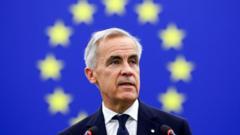
Canadian Prime Minister Mark Carney has announced his full support for a new mechanism intended to make Canada the first associate member of the European Union, in a speech delivered before the European Parliament in Strasbourg on Thursday. This announcement came hours after Commission President Ursula von der Leyen offered the EU opening the door for Canadian membership within a close cooperation framework covering defense, energy security, and critical materials. This move comes amid escalating trade tensions between Canada and the United States, where President Donald Trump described the idea as "laughable" and threatened to impose harsh tariffs if he deemed it an act of hostility.
Prime Minister Carney clarified that the world faces new storms including climate change, the erosion of democratic standards, and the use of trade as a weapon for economic pressure. He emphasized that the goal of this alliance is to create a positive model for democratic nations without seeking to form a power bloc competing with the United States or dominating others. He also noted that Canada is not in a position to join the EU fully at present, but is seeking a different framework that enhances the strategic autonomy of both parties.
Regarding the reaction of US President Donald Trump, Carney stated that this alliance represents a positive process and a definitive response to comments by the US president who expressed hesitation regarding Canada's intentions. He added that the Canadian people are united in rejecting any attempt to impose their language or culture on them or dictate their international partners from the outside. While von der Leyen clarified that associate membership status does not currently exist and may take years to implement, Carney confirmed that both sides have only just begun the journey toward the details of this unique cooperation.
A summit between the EU and Canada will be held in Montreal at the end of next October to study the precise details of these new proposals. The proposed cooperation includes exchanging technological resources and deepening human ties by allowing youth to work and study anywhere across the Atlantic. There has previously been cooperation in trade, defense, and research under an existing free trade agreement between the two sides.
Analysis & context
Analysis & Context
From an analytical perspective, the idea of associate membership represents an attempt to break the deadlock in EU-Canadian relations and redefine Canada's role as an independent strategic partner beyond exclusive reliance on the United States. This step is a direct response to current geopolitical shifts pushing countries toward building alternative alliances to ensure their economic and defense security amidst global instability.
In the broader context, the European Union faces significant challenges requiring it to diversify its strategic partners, particularly in energy and critical materials such as lithium and copper. The two sides have previously cooperated under free trade agreements and in fields of scientific research and defense, but this new framework aims to elevate the partnership to a deeper strategic level involving the exchange of technological resources and strengthening human ties between peoples.
Implementing any new arrangement remains dependent on the approval of all 27 EU member states, as some governments have previously expressed reservations about creating new forms of membership. Moreover, the summit scheduled for Montreal at the end of October will serve as a critical platform to study the precise details of this partnership and determine practical implementation mechanisms that ensure its sustainability and effectiveness over the long term.