Sourced fact
The News
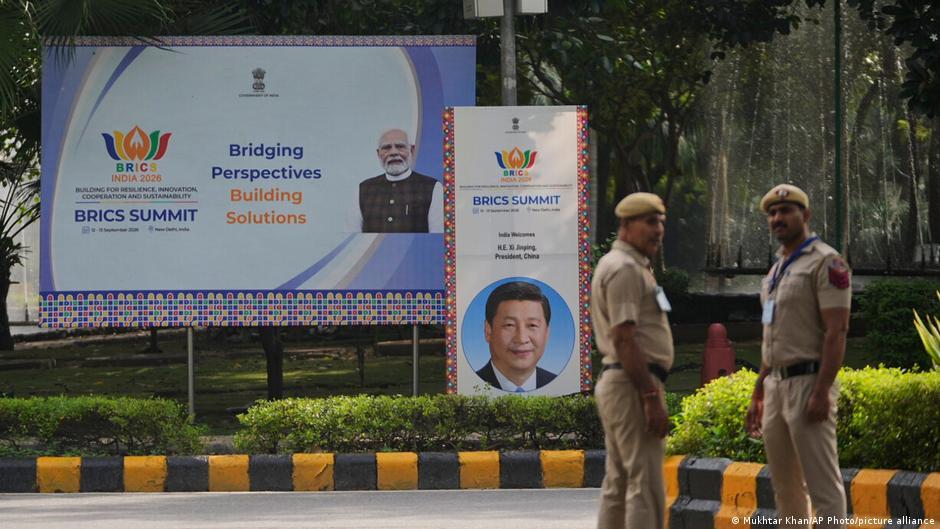
Indian Prime Minister Narendra Modi announced the adoption of the Joint New Delhi Declaration during the eighteenth BRICS summit held in India on September 12 and 13, 2026. While the bloc expressed deep concern over escalating tensions in the Middle East and called for maximum restraint, the historic summit also saw Modi meet Chinese President Xi Jinping for the first time since 2019 to discuss multiple issues including economic and technological cooperation—a cautious step toward thawing relations between the two nuclear powers despite ongoing distrust over border disputes. Modi also discussed a wide range of issues with Russian President Vladimir Putin, including the war in Ukraine and energy cooperation, where he once again urged Putin to end the war in Ukraine.
Regarding Iran’s position, a meeting took place between Modi and Iranian President Masoud Pirzahan in New Delhi to discuss protecting maritime trade, while Pirzahan warned of “critical and dangerous” U.S. economic pressures facing Iran. Notably, neither Ukraine nor Russia was mentioned by name in the final declaration text, despite the war affecting three BRICS members—Iran, the UAE, and Saudi Arabia—who stand on opposite sides of the conflict.
U.S. President Donald Trump was also not mentioned in the document despite his presence as an influential figure; BRICS leaders expressed their shared grievance against unilateral sanctions and Western tariffs. Modi recommended avoiding “arming technology and critical minerals” that could hinder global development, while Xi called for strengthening economic cooperation within a “Larger BRICS” framework to serve developing nations globally.
It is worth noting that BRICS began as an economic acronym proposed by Goldman Sachs in 2001 before officially transforming into a formal diplomatic alliance after South Africa’s accession in 2010, now standing as a bloc of eleven members striving to amplify the voice of the Global South.
Analysis & context
Analysis & Context
From an analytical perspective, the complete absence of any mention of Ukraine in the New Delhi Declaration represents a significant political shift compared to the previous Rio declaration, which merely referred to “national positions” of member states without condemning Russia’s invasion or calling for troop withdrawal. This total omission is politically beneficial for Putin, who was present in New Delhi, and reflects the reality that the BRICS alliance faces clear strategic limits in its ability to present a unified stance on major conflicts directly or indirectly affecting its members.
In the broader context, China seeks to transform the bloc into an integrated network for the Global South through its “Larger BRICS” initiative from both technological and geopolitical standpoints, while India aims to preserve its strategic autonomy and prevent BRICS from becoming a Western-led anti-Western alliance under Beijing’s direction. These fundamental tensions between the desire to represent the Global South and promote economic integration on one hand, and safeguarding conflicting national interests and preventing Chinese hegemony on the other, constitute the greatest challenge to the cohesion of the expanding bloc that now includes 11 member countries and 10 partner nations.
Historically, BRICS began as an economic acronym proposed by Goldman Sachs in 2001 to describe fast-growing economies in Brazil, Russia, India, and China, before officially becoming a diplomatic alliance in 2009, then expanding to include South Africa and other countries later. This historical evolution illustrates how a theoretical economic group transformed into a real geopolitical bloc attempting to offer an alternative to the Western-dominated global order, especially amid growing concern over “arming technology” and “critical minerals,” which Modi warned against in his opening speech.