Sourced fact
The News
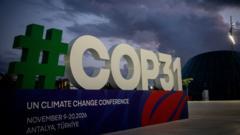
Reports from BBC News indicate that the 43rd climate summit held in Turkey ended with countries failing to reach a central political agreement known as the "Antalya Protocol" to strengthen climate change mitigation measures. Despite Australia and Turkey jointly leading the negotiations, these nations could not unify national delegations, particularly after a dramatic final day where several countries protested the complete absence of any mention of fossil fuels in the final texts.
The report highlights that the world is preparing for life exceeding 1.5 degrees Celsius above pre-industrial levels, the limit agreed upon by Paris countries in 2015 as an absolute maximum not to be exceeded. The draft agreement acknowledged an embarrassing reality that current climate actions have failed to achieve this most important goal, a fact which was subsequently lost due to the failure to reach a final agreement.
Regarding the fossil fuel issue, countries were unable to bridge the gap on including texts related to it despite a previous commitment made three years ago in Dubai. Wealthy nations also failed to specify an exact additional financial amount that could be provided to developing countries to adapt to climate change, raising serious questions about governments' ability to work together as the climate crisis intensifies.
At the end of the summit, British Energy Minister Michael Shanks stated that this session sought to confront difficult realities indicating that global warming would exceed 1.5 degrees Celsius and that we must work much harder to reduce emissions. European Union representative Drag O'Brien noted that negotiations were "stolen" by some oil-producing countries, while Russian Ambassador Sergey Kononchuk accused European nations of providing climate finance only in the form of loans, describing it as an old form of colonial distribution under a new banner.
On the positive side, an agreement was reached to direct funds from a global carbon credit issuance system to help developing countries adapt to the effects of climate change. Participants also agreed to develop a framework for a just transition aimed at protecting workers and communities as the global economy shifts towards clean energy, while some important items such as the work program to reduce emissions will be addressed at the next climate summit.
Fethi Berrol, head of the International Energy Agency, clarified that the world has already entered an "age of electricity" rather than merely entering it, noting that energy security and price fluctuations are driving countries to abandon imported fossil fuels in favor of local electricity generation.
Analysis & context
Analysis & Context
From an analytical perspective, the failure of the COP31 summit is a serious blow to the practical credibility of the UN climate process aimed at coordinating global efforts to face a rapidly intensifying climate crisis. The inability to reaffirm previous commitments or reach new texts on fossil fuels indicates an erosion of mutual trust among member states in the international system's ability to work collectively.
In the broader context, reports from the International Energy Agency suggest that external factors such as energy security and price changes have become a main driver for the transition to clean energy, thereby reducing the importance of official negotiations in determining the speed of this economic shift. Furthermore, rapid technological development in areas like solar panels and batteries makes private investment more influential than pure political decisions in guiding the path of the global energy transition.
It is worth noting that carbon removal through tree planting or technological solutions was discussed for the first time at this summit, reflecting a shift in methodology for dealing with atmospheric emissions despite ongoing debate over the viability and efficiency of some of these technologies.
Finally, continued work on other items such as the carbon credit system and the just transition framework demonstrates that political failure does not necessarily mean the cessation of all field and programmatic efforts to implement previous agreements or address financial adaptation issues in fragile countries.