Sourced fact
The News
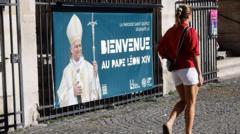
Pope Leo XIV issued a warning about the dangers of artificial intelligence at the start of his four-day visit to France, cautioning against the risk of humanity being lost amidst a "machine paradise" during his discussions with President Emmanuel Macron at the Élysée Palace. These warnings come after the Pope previously called this year for the necessity of "equipping" artificial intelligence and warning the world against the normalization of exploiting humans akin to the slave trade.
The French President described the visit as a "great dignity," affirming that French secularism does not deny religion in any form, while the Pope emphasized that true secularism must not exclude religion from the public sphere or education. It is expected that more than half a million people will attend a massive mass in Paris on Saturday at the Place de la Concorde, while President Macron did not attend any of the masses to respect the separation of church and state in France.
The Pope will tour the castle with a small drone over a large crowd before meeting a group of migrants in Paris and visiting victims of sexual abuse by clergy in Lourdes. He will also offer congratulations to Alfred Schumann, founder of the European Union, in Metz on Monday, where he is considered a candidate for canonization.
This visit marks a significant event reflecting growing interest in spirituality among French people and other Europeans despite the historical decline in the number of regular Catholic practitioners. Cardinal François Bozo Bellocchio noted that while France has been secularized, there is a vacuum where God and values once existed, pointing out that Pope Leo XIV will awaken the West as Pope John Paul II did with the East.
Analysis & context
Analysis & Context
From an analytical perspective, Pope Leo XIV's stance on artificial intelligence continues his previous path in teachings linking ethical technological progress with the protection of human dignity. His warning against "losing humanity" reflects growing concern among religious leaders about how to integrate new technologies without compromising spiritual and ethical values that form the core of human identity.
In a broader context, the relationship between France and the Catholic Church is marked by historical complexity, having transformed from the "great daughter of the church" into a strict secular state under the 1905 law separating church and state. Despite a significant decline in regular worship attendance since the 1960s, recent statistics indicate a notable resurgence of interest in religious traditions, with adult baptisms doubling in recent years.
Cardinal François Bozo Bellocchio explains that secularization has created a spiritual vacuum that people are seeking to fill through visits to the Pope, who brings a reminder of their roots, noting that Pope John Paul II awakened the East while Leo XIV will take on the role of awakening the West. This shift points to a new dynamic in the European religious landscape as societies seek to rediscover their spiritual roots amidst modern challenges.
The Pope's visit also sparks debate around the balance between French secularism and respect for religious freedoms, with President Macron refusing to attend masses to avoid violating the strict separation between state and religion, while affirming that true secularism does not exclude religion from the public sphere or education.