Sourced fact
The News
Major world leaders gathered in New Delhi this week around a massive roundtable to adopt a joint declaration representing an attempt to establish a new global system outside Western dominance amidst acute geopolitical tensions. Indian Prime Minister Narendra Modi described the attendees as "rule-makers" rather than mere followers, while leaders from BRICS countries—including China, Russia, Iran, India, South Africa, and the United Arab Emirates—listened attentively.
This gathering is considered a major diplomatic achievement given that some attendees are not natural allies; India and China engaged in deadly military clashes on their border in 2020, while Iran and the UAE are locked in a regional conflict in the Middle East. Nevertheless, the leaders succeeded in overcoming deep differences to issue a statement condemning attacks on civilian infrastructure and peaceful nuclear sites and calling for maximum restraint without blaming any specific party.
The declaration notably omits any mention of the war in Ukraine, a clear departure from the group's previous conventions, while avoiding naming the United States despite condemning unilateral tariffs that might anger U.S. President Donald Trump. Analysts suggest that this neutral approach reflects India's policy of maintaining relationships with opposing countries without explicitly entering anti-Western alliances.
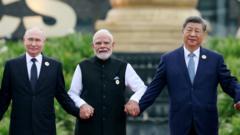
On the humanitarian front, leaders seized the opportunity to hold direct negotiations between Iran and the UAE for the first time since the start of the war, providing a platform for Iran to demonstrate it is not alone amid U.S. military and economic pressures. The meeting between Chinese President Xi Jinping and Indian Prime Minister Narendra Modi also featured a friendly handshake despite historical tensions, with both agreeing to strengthen trade and transport links to address a significant trade deficit favoring China.
Experts hope these steps will lead to strategic autonomy in an era of war and enhanced mutual cooperation among group members, but the biggest challenge lies in defining the shape of the new global system and how to practically achieve it. Although the summit succeeded in creating space for dialogue between adversaries outside dominant Western institutions, the question remains whether these agreements will produce tangible progress or remain mere words without real implementation on the ground.
Analysis & context
Analysis & Context
From an analytical perspective, the BRICS alliance serves as a platform for countries like China, Russia, and Iran to mitigate U.S. and Western European dominance, while India carefully avoids portraying the alliance as an anti-Western bloc to preserve its relationships with all parties. Indian diplomat Anil Trigunayit noted that New Delhi's achievement was pushing toward "strategic autonomy in an era of war" and enhancing mutual cooperation rather than fostering division.
In a broader context, this summit follows commercial threats from President Donald Trump and shocks from the Middle East war, making reshaping the global system an urgent need for member economies. The summit provided a platform for meetings that seemed impossible just months ago, including direct talks between Iranian President Masoud Pezeshkian and Abu Dhabi Crown Prince Sheikh Khubaid bin Mohammed bin Zayed Al Nahyan for the first time since the war began.
Chinese President Xi Jinping's visit to New Delhi also marked a historic moment after seven years as his first trip there, easing tensions following the border conflict, with agreements reached to strengthen trade and transport links despite China's significant trade deficit. Experts confirm that these steps represent part of a gradual warming in relations, though the real challenge lies in how to implement agreements and overcome obstacles to future trade and investment.
Finally, the summit demonstrated BRICS' ability to create space for adversaries to negotiate outside dominant Western institutions, but the most important question is what will replace the current global system and how it can be practically achieved.