Sourced fact
The News
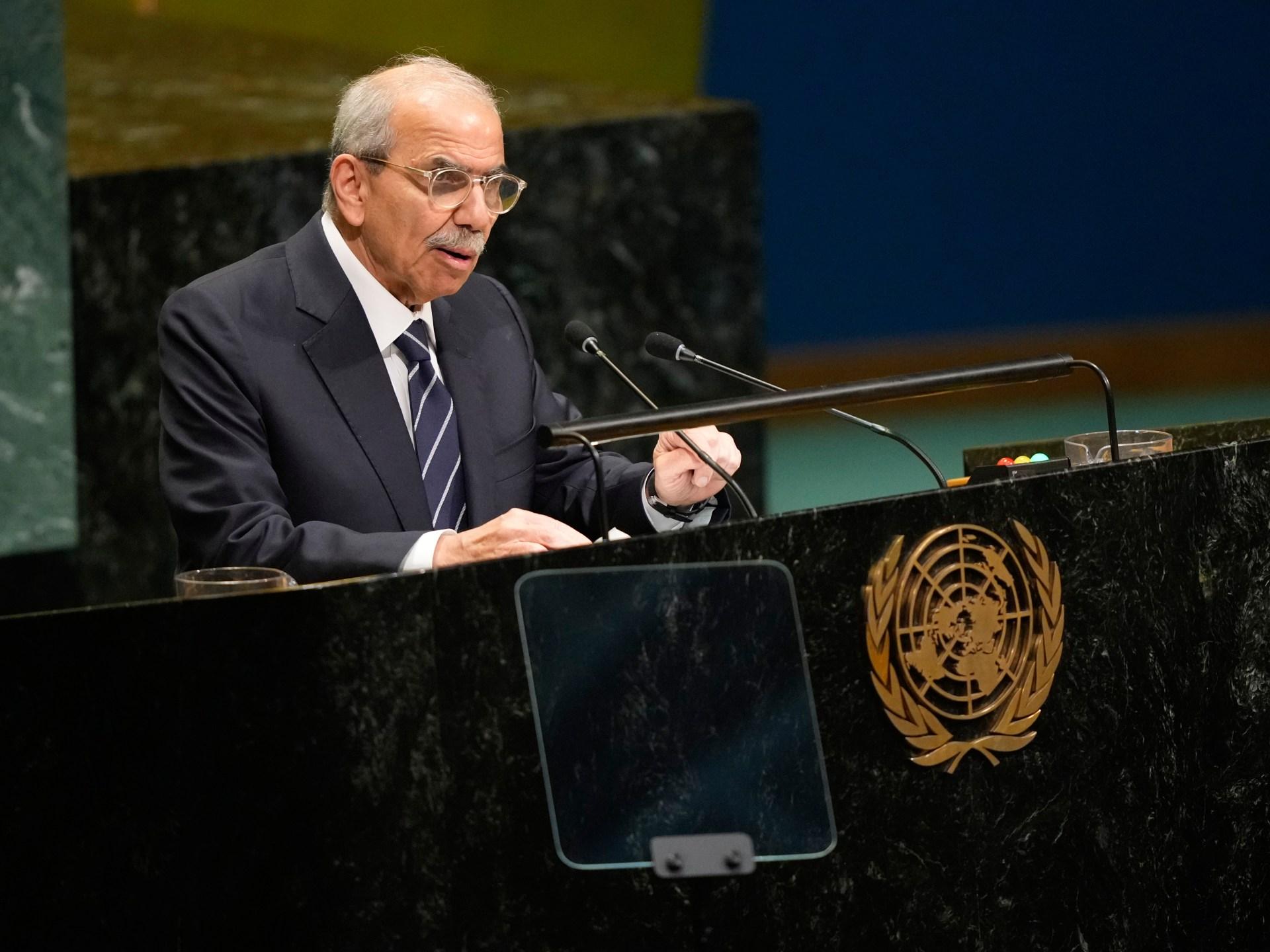
Lebanese Prime Minister Nawaf Salam called for an end to the Israeli occupation of southern Lebanon and the imposition of a full ceasefire amidst ongoing Israeli bombing and explosions, in a speech delivered at the United Nations General Assembly in New York on Friday. His key demands included the complete withdrawal of Israeli forces from Lebanese territory up to internationally recognized borders and the release of all Lebanese detainees.
The Prime Minister clarified that reality on the ground proves the war is far from over, pointing to the continued presence of Israeli drones and military aircraft flying at low altitudes over areas such as Froun, alongside ongoing artillery shelling causing uncontrollable fires. He also noted that the Lebanese Civil Defense and firefighters were prevented from reaching fire zones to extinguish them, while more than 60 towns in the south remain under Israeli occupation where systematic campaigns are being conducted to demolish homes despite the ceasefire agreement.
Salam stated that the Lebanese government has entered negotiations with Israel under American mediation led by President Donald Trump aimed at ending the war and restoring Lebanese sovereignty, emphasizing that the success of any agreement is measured by fulfillment of commitments, not merely intent. He stressed the necessity of converting this agreement into practical steps within a clear timeline and an implementation mechanism ensuring all provisions are executed, considering that state sovereignty cannot be sacred in one place and negotiable in another.
He added that the Prime Minister guarantees government oversight over Hezbollah's disarmament in exchange for Israel's complete withdrawal, clarifying that weapons must remain solely under state control and that decisions regarding war and peace rest exclusively with constitutional institutions. He also linked Lebanon's stability to that of the entire region, asserting that lasting stability in Lebanon cannot exist without regional stability based on respecting Palestinian rights and their right to self-determination.
Analysis & context
Analysis & Context
From an analytical perspective, Lebanese Prime Minister Nawaf Salam's speech focuses on the principle of national sovereignty which is non-negotiable in certain areas while committing to international law in others, reflecting the tension between the Israeli military reality and Lebanese political demands. Salam indicated that Middle East stability can only be achieved through respect for Palestinian rights, viewing the UN's inability to enable the Palestinian people to exercise their right to self-determination as a major obstacle to regional stability.
In the broader context, the role of the framework agreement mediated by the United States in June emerges as a roadmap for the gradual withdrawal of Israeli forces and the Lebanese Army's presence in abandoned areas, though the challenge lies in translating this agreement into practical steps with a clear timeline and a mechanism to verify the implementation of all its provisions. Furthermore, the Prime Minister's pledge to oversee Hezbollah's disarmament in exchange for Israel's complete withdrawal places the Lebanese government before enormous security and political challenges requiring a delicate balance between national interests and international obligations.
Salam's speech at the UN is considered a pivotal moment reflecting a shift in Lebanese political discourse toward explicitly demanding state rights, particularly amidst ongoing human and material destruction in the south. The connection Salam drew between Lebanon's stability, regional stability, and Palestinian rights highlights the interconnected nature of crises in the Middle East, where resolving any one issue is intrinsically linked to others.