Sourced fact
The News
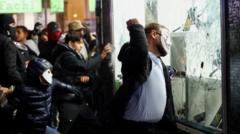
Riots and looting erupted in central Frankfurt late Saturday night, while clashes broke out in other German cities in protest against rising living costs. The German capital Berlin and the cities of Cologne and Hamburg witnessed violent incidents involving thousands of protesters organized by a youth alliance aiming to demand improved public services and reject compulsory military service.
A spokesperson for the police in Frankfurt stated that special units were deployed in the city center, where demonstrators smashed shop windows and threw Molotov cocktails at emergency vehicles. The official added that authorities arrested numerous suspects ahead of them; security forces used water cannons to disperse crowds that targeted rescue workers with stones and glass bottles.
Lina Friedrich, a spokesperson for the group "Gen Z regelt," stated that the protests aim to defend peace and sanctity rather than war and coercion. She noted that key demands include better support for health and education systems, opposition to compulsory military service, and a fairer distribution of financial burdens among citizens.
Regarding the broader context, Bild newspaper reported that German Interior Minister Alexander Dobrindt said police had successfully prevented violence similar to what Paris witnessed in recent weeks. The minister also called for harsh penalties on those involved in looting and assaults, asserting that what happened in Frankfurt differs fundamentally from the peaceful protests that preceded the chaos.
Interior Minister Heike Ruman-Bosik stated that about 100 clearly identified left-wing extremists had infiltrated the city demonstrations, describing the end of the rallies as shameful compared to the painful images from France. He added that authorities did not wish to be seen as a role model in this regard, warning against repeating scenarios involving burning houses and police cars, and attacking security personnel.
Cologne saw an attack on police officers near the main train station where bottles were thrown and a bicycle hurled at them. In Berlin, 27 officers were injured during an evening demonstration that led to up to 56 arrests, while 120 people were arrested in Hamburg after protesters set up barricades and set off fireworks.
The German protests coincided with massive demonstrations in France involving over 320,000 people calling for improved public services and reduced living costs. Italy, Portugal, Spain, Greece, and other regions across Europe also saw similar protests focusing mainly on housing, education issues, and cuts to public services.
Analysis & context
Analysis & Context
From an analytical perspective, these events highlight growing social tension in Germany due to the economic crisis the country is facing, with protesters primarily focusing on issues such as living costs, rising housing prices, and declining quality of education. The transformation of peaceful demonstrations into riots indicates the presence of extreme elements who exploited the opportunity to create chaos—a development that has alarmed German authorities, who warned against viewing France as a model to emulate in this context.
In the broader context, these protests in Germany occurred on the same day Europe witnessed widespread demonstrations in countries like France, Italy, Spain, and Portugal, where protesters also focused on living costs and public services. The similarity in demands across these nations reflects a shared regional economic crisis affecting youth particularly, prompting them to take to the streets to demand urgent reforms.
Police reports from Germany and France indicate that violence was not a characteristic of all demonstrators but rather resulted from the infiltration of extreme elements or violent reactions from some participants. The use of water cannons and tear gas by authorities in both countries reflects a strict security response to the challenges posed by large-scale protests on European urban stability.
Finally, the continuation of these protests across several weeks in France and Germany shows that the issues raised by demonstrators are not temporary but structural matters requiring radical solutions from European governments. The ability of organizational groups such as "Gen Z regelt" and "Gilet Jaune" to mobilize large numbers of youth indicates widespread public anger requiring immediate political and social intervention to prevent future escalation of violence.